Trusted Taxi Booking App Development Partner for Global Mobility Businesses

14 +

Years of Experience

500 +

Projects Delivered

100 +

Countries Served

50 +

Dedicated Developers

3 +

Platforms Supported

4.8 / 5

Client Satisfaction

Grepix Overview

Taxi Booking App Development Company Building
Scalable Ride-Hailing Software

Taxi app development today goes far beyond booking rides online. Modern ride-hailing businesses need an intelligent software ecosystem capable of managing passengers, drivers, dispatchers, fleet operators, payments, analytics, promotions, and customer support from a single platform.

As a taxi app development company, Grepix designs and builds complete taxi booking ecosystems that help entrepreneurs and transportation companies launch scalable ride-hailing businesses across local, regional, and international markets. Every solution is engineered for high performance, data security, feature flexibility, and long-term growth.

Whether you're building a startup, expanding an existing taxi company, or digitizing a traditional fleet operation, our taxi app development services provide the technology foundation needed to compete in today's on-demand transportation industry. Our engagements typically cover:

  • White-Label Taxi App Development — rebrand and launch a ready-built ride-hailing platform fast
  • Custom Ride-Hailing App Development — build a fully bespoke platform around your business model
  • Driver & Passenger App Development — native or cross-platform apps for iOS and Android
  • Fleet & Dispatch Management Software — centralized control over vehicles, drivers, and trip assignment
  • Admin Panel & Analytics Dashboard — real-time visibility into rides, revenue, and performance
  • Payment Gateway & API Integrations — secure, region-specific payment and third-party integrations
Understanding the Basics

What is Taxi Booking App Development?

Taxi app development is the process of designing, developing, and deploying software that enables passengers to book rides, drivers to accept trips, and businesses to manage their transportation operations through a centralized digital platform. A complete taxi app solution typically includes passenger apps, driver apps, dispatcher software, fleet management tools, and an administrative dashboard.

In practice, the work involves more than building one mobile app. A ride-hailing platform is several connected systems exchanging data in real time, and each of them has to hold up under load:

  • Passenger Mobile Application — for booking, tracking, and paying for rides
  • Driver Mobile Application — for accepting trips and managing earnings
  • Dispatcher Dashboard — for coordinating rides and assigning drivers
  • Fleet Management Panel — for tracking vehicles and drivers
  • Admin Dashboard — for overseeing the entire platform
  • Analytics System — for business performance insights
  • Payment Gateway — for secure, cashless transactions
  • Notification System — for real-time trip and offer alerts
  • GPS Tracking — for live location and route visibility
  • Route Optimization — for faster, more efficient trips
  • Dynamic Pricing Engine — for demand-based fare calculation
  • Customer Support Module — for resolving rider and driver issues

These components enable transportation businesses to automate operations, reduce manual effort, improve customer satisfaction, and scale efficiently.

Passenger App Driver App Dispatcher Panel Fleet Manager Admin Dashboard

A simplified view of how the passenger app, driver app, dispatcher panel, and fleet manager all connect through a central admin dashboard.

Taxi App Workflow

See the Complete Rider-to-Driver-to-Admin Workflow

Step-by-step screens showing exactly how booking, dispatch, tracking, payments, and ratings work together.

Business Impact

Why Businesses Are Investing in Taxi Booking App Development

Today's transportation industry is driven by convenience, speed, and digital experiences. Customers expect to book rides instantly, track drivers in real time, make cashless payments, and receive reliable service — and a well-built taxi app is what makes that possible at scale.

For businesses, investing in a taxi app delivers measurable operational and financial benefits:

  • Automate ride booking — reducing dependence on manual phone dispatch
  • Reduce operational costs — through smarter routing and dispatch
  • Increase driver productivity — with fewer idle hours and faster matching
  • Improve customer retention — through a consistent, reliable experience
  • Expand into new markets — with a platform built to scale
  • Generate recurring revenue — via commissions, subscriptions, and add-on services
  • Analyze business performance — using real-time data and reporting
  • Scale without proportional overhead — as automation replaces manual processes

See These Benefits Working in Your Own Market

Every business model is different — let's map these advantages to your specific city, fleet size, and rider base.

Market Opportunity

The Growing Global Ride-Hailing Market

Market Size & Growth

The global ride-hailing market was valued at roughly $285 billion in 2025 and is projected to reach over $716 billion by 2034, growing at a CAGR of about 10.8%.

Source: Fortune Business Insights

Smartphone Penetration

Around 5.6 billion people now use smartphones worldwide, representing roughly 70% of the global population — the foundation that makes app-based ride booking possible at scale.

Source: GSMA / DataReportal, 2026

Digital Payment Adoption

Digital payments now account for around 66% of global e-commerce transaction value, up from just 34% in 2014, reflecting the shift toward cashless, in-app ride payments.

Source: Worldpay (FIS) Digital Payments Guide

Urban Mobility Trend

Major ride-hailing platforms recorded roughly 11.3 billion trips globally in 2024, underlining just how central app-based mobility has become in daily urban life.

Source: Industry Research (Ride-Hailing Market Report)

EV Taxi Adoption

The global electric vehicle taxi market is projected to grow from about $27.5 billion in 2026 to $90 billion by 2035, as fleet operators shift toward electrification.

Source: Global Market Insights

AI in Transportation

The global AI-in-transportation market was sized at roughly $5.5 billion in 2025 and is forecast to reach nearly $35 billion by 2034, driven by AI-based dispatch and route optimization.

Source: Precedence Research

The rapid growth of urbanization, smartphone adoption, cashless payments, and AI-powered transportation is creating significant opportunities for taxi businesses worldwide. Companies investing in scalable ride-hailing technology today are better positioned to compete in increasingly digital transportation markets.

Built For Ride-Hailing Businesses

A Complete Taxi App Built Around How Your Business Actually Runs

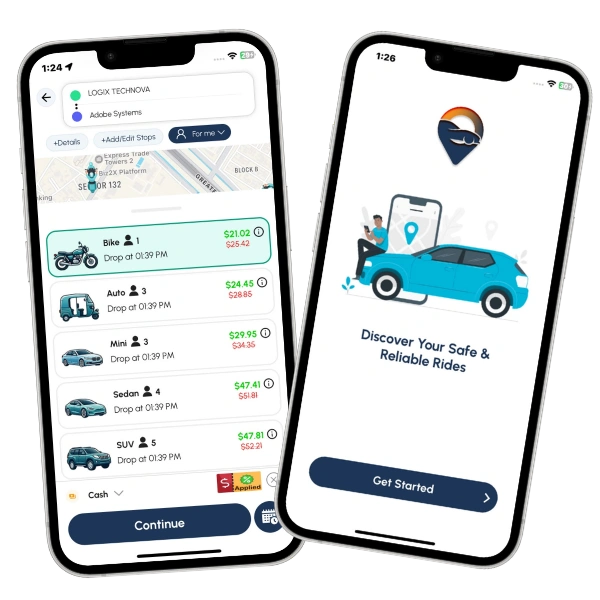
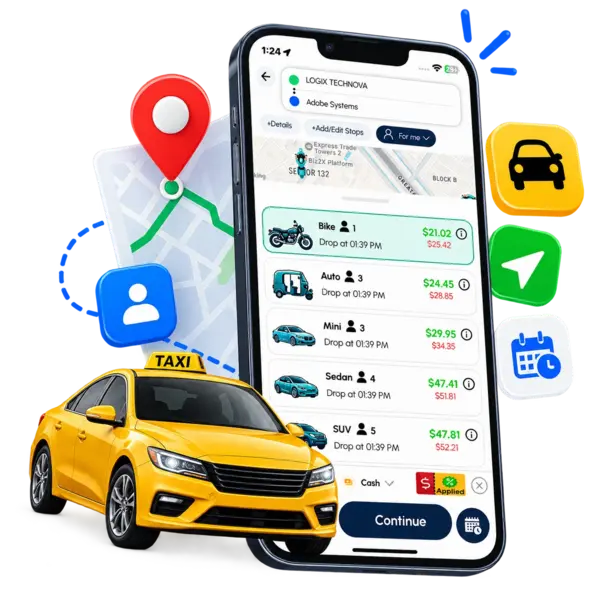
passenger and driver taxi app screens showing pickup location, live fare estimate, and vehicle selection

Running a taxi fleet without a dedicated booking app means missed bookings, manual dispatch over phone calls, and drivers who don't know where to go next. Grepix Infotech builds taxi apps that bring your entire operation — passenger bookings, driver assignment, live tracking, in-app payments, and fleet oversight — onto one connected platform, with a dedicated app for every role: passenger, driver, dispatcher, admin, and fleet owner.

Whether you're launching a new ride-hailing brand or moving an existing taxi business off paper registers and phone dispatch, you can start from our white-label taxi app to launch fast, or go with a custom build if your fare rules, vehicle categories, or dispatch logic don't fit a template.

What a Reliable Taxi App Needs to Get Right

Booking is the easy part. What separates a taxi app riders and drivers actually stick with is accurate live GPS tracking, a fare estimate shown before the ride is confirmed (not after), payment that works whether the market runs on cards, wallets, or cash, and a driver app that doesn't fight the person using it. Every module we build — passenger, driver, dispatcher, admin, and fleet — is designed around those fundamentals first. See the complete feature list →

taxi app
taxi app
taxi app
taxi app
taxi app
taxi app
Our Services

Custom Taxi Booking App Development Services

Ride-Hailing App Development

On-demand ride-hailing apps with real-time tracking, instant driver matching, and secure payments — passenger app, driver app, and admin panel included.

Cab Booking App Development

Cab booking platforms with ride scheduling, live fare estimation, and multiple payment options, so riders know the price before they confirm.

Carpooling App Development

Carpooling apps with route optimization and rider matching, built for shared commutes that split the cost between riders.

Car Rental App Development

Self-drive and chauffeur-driven rental apps with vehicle availability, flexible booking, and integrated payments.

Limousine App Development

Premium, luxury-focused booking apps with VIP profiles, advanced scheduling, and a polished ride experience for high-end clients.

Fleet Management App Development

Centralized fleet tools for live tracking, driver performance monitoring, and maintenance scheduling to keep operations efficient.

Corporate Taxi App Development

Employee ride scheduling, expense tracking, and corporate billing built for businesses managing staff transportation.

Bike Taxi App Development

Lightweight, quick-booking bike taxi apps with GPS tracking and wallet-based payments for affordable urban commutes.

Airport Transfer App Development

Reliable airport pickup and drop apps with fixed fares, live flight tracking, and advance booking options.

taxi app
taxi app
taxi app
taxi app
taxi app
taxi app
Why It Matters

Why Every Taxi Business Needs a Custom App

taxi booking app

Passengers today expect to book, track, and pay for a ride in a few taps — not phone calls and manual dispatch. A dedicated taxi app lets your business meet that expectation while giving you tools you simply can't get from generic booking methods.

Beyond convenience, a custom app gives you real operational control:

  • Efficient Dispatch: Automated driver matching cuts down passenger wait time and reduces idle driver hours.
  • Transparent Payments: In-app payments and fare estimation build trust and reduce disputes.
  • Driver Retention: Earnings dashboards and fair ride distribution keep your driver fleet engaged.
  • Data-Driven Growth: Ride analytics and reporting help you spot demand patterns and expand intelligently.
Key Benefits

Benefits of Taxi Booking App Development

Here's what actually changes once your rides move into an app — for your revenue, your drivers, your office team, and your passengers.

Increase Revenue Through Digital Bookings

Your taxi app takes bookings 24/7 — no phone operator needed, no missed calls at 2am. Every booking, cancellation, and completed trip is recorded, so you can finally see where your demand really comes from. You can also run surge pricing, discount offers, and loyalty rewards straight from the app, which was never possible over the phone.

Improve Customer Experience

Riders want three things before they confirm a trip: where the driver is, when the car will arrive, and what the ride will cost. A good taxi booking app shows all three upfront. Add in-app chat, driver ratings, and ride history, and the service starts to feel dependable — and riders come back to the app they trust.

Optimize Fleet Operations

A fleet management dashboard shows every vehicle and driver live — who's online, where they are, and how they're performing. You can shift drivers toward busy areas instead of guessing, and keep service dates and document renewals in one place. As the fleet grows, this is what keeps it manageable.

Reduce Manual Dispatch Costs

Matching rides over the phone is slow, and staffing a call centre gets expensive as you grow. Automated dispatch finds the nearest free driver in seconds, so you need fewer operators for the same number of rides. Pickups get quicker too — passengers wait less, and drivers spend more time earning.

Real-Time Driver Tracking

Live GPS tracking helps everyone. Riders know exactly when their car will reach them, your team can watch active trips and step in if something goes wrong, and every route and timing is saved. If a fare disagreement or safety complaint ever comes up, you have a clear record to check instead of two different stories.

Secure Digital Payments

In-app payments mean less cash in the car and less risk for your drivers. Cards, wallets, and popular local payment methods are all supported, and your commission is split automatically — no counting up at the end of the day. You also get a clean record of every transaction, so fare disputes become rare.

Business Analytics and Reporting

Your app collects useful information every single day: busy hours, popular routes, driver performance, and rider habits. Simple reports turn that into decisions — what to charge, which drivers to reward, which area to enter next. You stop running the business on gut feeling.

AI-Based Route Optimization

Smart routing checks live traffic, distance, and past trip patterns to pick the quickest way. Drivers use less fuel and finish more rides in a shift, while riders get shorter, more predictable trips. In short, you get more out of the same vehicles without buying another car.

Scalable Cloud Infrastructure

A cloud-based platform grows with you — more rides, more users, more cities, without rebuilding anything. It matters most on your busiest days, like festivals or long weekends, when bookings spike and the app still has to feel quick. Updates also reach every city at once.

Expand to Multiple Cities and Countries

The platform is built once and then configured for each market. Entering a new city or country means onboarding local drivers and adjusting fares, language, and payment options — not starting the app over. That's why a proper taxi app development solution pays off early: the same setup running your first city can run your tenth.

How We Compare

Where a White-Label Solution Stands Out

A white-label taxi app is a ready-built platform you brand and launch as your own, which shortens go-live from months to weeks. It fits best when your booking and dispatch workflows are close to standard ride-hailing. Custom taxi app development is the better choice when your pricing rules, dispatch logic, or local compliance requirements differ from how the market normally works.
Capability Typical Ride-Hailing Apps Grepix White-Label Solution
Passenger, Driver & Dispatcher Apps ✔ Included ✔ Included
Fleet Management Dashboard Varies by platform ✔ Included
AI-Based Dispatch & Route Optimization Varies by platform ✔ Included
White-Label Branding (Your Own Brand) Rarely available ✔ Included
Full Source Code Access Rarely available ✔ Included
Lifetime Ownership (One-Time Purchase) Rarely available ✔ Included

Comparison reflects general industry patterns for consumer ride-hailing apps versus white-label taxi app solutions, and is not a claim about any specific named company or product.

Ready to Build Your Own Ride-Hailing Brand?

Stop paying commission to someone else's platform — launch a taxi app that's fully yours, branded and priced your way.

Our Process

Our Proven Taxi Booking App Development Process

Six clearly defined stages take you from the first conversation to a live app on both stores — with a single point of contact and something to review at the end of every stage.

  1. Step 01

    Requirement Analysis

    We start by understanding your business model, target market, and must-have features.

  2. Step 02

    UI/UX Design

    Wireframes and screen designs that keep the rider and driver experience simple and intuitive.

  3. Step 03

    App Development

    Our engineers build the passenger app, driver app, and admin panel in parallel.

The six stages of Grepix's taxi app development process, from requirement analysis through to maintenance and support
  1. Step 04

    Integration & Testing

    Payment gateways, maps, and SMS/notification services are integrated and thoroughly tested.

  2. Step 05

    Deployment

    We publish your apps to the App Store and Play Store and set up your production server.

  3. Step 06

    Maintenance & Support

    Ongoing updates, bug fixes, and feature enhancements once your app is live.

Investment & Planning

Taxi App Development Cost: What Does It Take
to Build a Ride-Hailing Platform?

The cost of taxi app development depends on several factors, including the number of features, supported platforms (Android, iOS, Web), UI/UX complexity, third-party integrations, scalability requirements, and whether you choose a custom-built or white label solution. Businesses can launch faster with a white label taxi app or invest in custom taxi app development for unique workflows and branding.

Cost varies because requirements do. A local taxi company serving one city has very different technical needs from a ride-hailing software platform preparing to operate across several countries — different feature depth, different infrastructure, and a different amount of compliance work.

Knowing which factors actually move the number is what lets you choose between a white label taxi app and an Uber clone app built around your own workflows, and avoid paying for scale you won't use in your first year. The six factors below change the estimate most.

What Determines the Cost of Taxi App Development?

Six core factors decide the final taxi app development cost — from your business model and target platforms to feature depth, integrations, design, and compliance needs.

Business Model

The type of ride-hailing business you're running directly shapes the feature set and, in turn, the cost to build a taxi app.

  • Local Taxi
  • Airport Taxi
  • Corporate Taxi
  • Ride Sharing
  • Bike Taxi
  • Rental
  • Chauffeur
  • Fleet Management

Platforms

Every additional platform increases development effort, QA time, and long-term maintenance cost.

  • Android
  • iOS
  • Web
  • Admin Panel
  • Dispatcher Panel
  • Fleet Panel

Number of Features

Basic booking flows cost less than advanced or enterprise-grade functionality. Richer feature sets take longer to build and test, which raises both upfront cost and ongoing maintenance.

  • Basic
  • Advanced
  • Enterprise

Third-Party Integrations

Maps, payments, messaging, and analytics integrations each add development and testing effort.

  • Google Maps / Mapbox
  • Stripe / PayPal
  • Twilio / SMS Gateway
  • Firebase & Push Notifications
  • Analytics

Design Complexity

A fully custom, branded UI with animations, accessibility, and multi-language support takes more design and development time than a standard template.

  • Custom UI
  • Branding
  • Animations
  • Accessibility
  • Localization

Scalability & Compliance

Platforms built for single-city operation cost less than those engineered for multi-country scale, and applicable compliance depends on where the platform operates.

  • Single City / Multi-City / Multi-Country
  • GDPR (Europe)
  • CCPA (California)
  • PCI DSS (Payments)

Indicative Cost & Timeline Comparison

SolutionBest ForTypical TimelineCustomization
White Label Taxi AppFast LaunchShortMedium
Custom Taxi App DevelopmentUnique Business ModelsLongerHigh
Enterprise Mobility PlatformLarge OperatorsLongestVery High

We avoid publishing fixed pricing since actual cost depends on your specific feature set and scope — the table above is directional, not a quote.

White Label vs Custom Taxi App Development

White LabelCustom Development
Faster launchBuilt from scratch
Lower initial investmentHigher flexibility
Proven workflowsTailored business logic
Branding supportFully unique experience
Ideal for startupsIdeal for enterprises

Want an Accurate Cost Estimate?

Instead of guessing your budget, speak with our mobility experts. We'll analyze your business model, deployment goals, required features, and growth plans to provide a tailored proposal.

Project Roadmap

Taxi App Development Timeline: How Long
Does It Take to Build a Taxi App?

A white label taxi app can go live in weeks, while a fully custom ride-hailing software build spans several phases from planning to post-launch support. Here's what a typical taxi app development timeline looks like:

1

Business Analysis

Requirement gathering & project planning

2

UI/UX Design

Wireframes & prototype

3

Frontend Development

Passenger, driver, admin, dispatcher & fleet apps

4

Backend Development

APIs, authentication, payments, maps, notifications, database

5

Testing

Functional, performance, security & compatibility

6

Deployment

Google Play, Apple App Store & cloud infrastructure

7

Maintenance

Updates, monitoring, support & feature enhancements

Planning Design Development Testing Deployment Support
Built to Last

Technology Stack for Modern Taxi Booking App Development

The right taxi app technology stack directly affects performance, scalability, maintainability, and security. We only build with technologies our team actively supports and has shipped in production — here's the stack behind our taxi app development solutions.

Mobile Apps

Native development — Android with Java/Kotlin and iOS with Swift — for the best possible performance, smooth animations, and full access to device-level features like GPS and push notifications.

Backend

PHP/Laravel and Node.js power our APIs, chosen for reliability, scalability, and long-term maintainability.

Database

MySQL and PostgreSQL for structured data, with Redis for high-speed caching.

Cloud

Deployment flexibility across AWS, Google Cloud, or Microsoft Azure, based on your region and infrastructure preferences.

Maps

Google Maps powers live tracking, geofencing, geocoding, and turn-by-turn route optimization.

Payments

Stripe, PayPal, Razorpay, PayU, Apple Pay, Google Pay, in-app wallet, and cash — integrated based on your target markets.

Notifications

Firebase Cloud Messaging, APNs, SMS, email, and WhatsApp notifications to keep riders and drivers informed in real time.

Analytics

Google Analytics, Firebase Analytics, and business intelligence dashboards for ride, revenue, and performance insights.

Enterprise-Grade Security

Every taxi app we build is developed with security as a core requirement, not an afterthought.

HTTPS everywhere
JWT / OAuth authentication
Password hashing
Data encryption
Role-based access control
API security
Audit logs
Backup strategy

Scalability & Deployment Options

A well-architected taxi booking platform should grow with your business, from a single city to a global footprint, without a ground-up rebuild.

Single City Multiple Cities National Expansion Global Deployment

This is supported through load balancing, caching, a CDN, database optimization, queue processing, and continuous monitoring. On the infrastructure side, we support cloud, on-premise, and hybrid deployment — cloud offers the fastest setup and easiest scaling, on-premise suits businesses with strict data-residency needs, and hybrid balances both.

Taxi App Maintenance

Launch is just the beginning. Our taxi app maintenance covers bug fixes, OS updates, security patches, performance optimization, feature enhancements, and ongoing technical support, so your platform keeps running smoothly as your business grows.

Free Tools

Plan Your Investment & Estimate Your Returns

Use our free interactive tools to get an instant, indicative picture of your taxi app project before you talk to our team.

Taxi App Cost Calculator

Select your platforms, region, and feature tier to get an instant, indicative investment range for your taxi app project.

Open Cost Calculator →

Taxi App ROI Calculator

Estimate your monthly commission, break-even time, and 12-month earning potential from your taxi business.

Open ROI Calculator →
Simple Flow

How the Taxi Booking App Works

A taxi booking app works in five steps. The passenger requests a ride and sees the fare upfront, the system matches the nearest available driver, the driver accepts and navigates to the pickup point by GPS, the trip is tracked live until drop-off, and payment is settled in-app with your commission deducted automatically. Ratings from both sides close the loop.
1

User Registration

Riders sign up in seconds with a mobile number or email.

2

Ride Booking

Set pickup and drop points and confirm the ride.

3

Driver Matching

The nearest available driver is matched automatically.

4

Ride Confirmation

Rider and driver get trip and ETA details instantly.

5

Payment

Fare is settled via card, wallet, UPI, or cash on completion.

Use Cases

We Build Taxi Apps for Various Industries

Ride-Hailing Services

Corporate Fleets

Airport Transfers

Local Taxi Services

Luxury Car Rentals

Medical Transport Services

Carpooling and Ride Sharing

Delivery & Logistics Services

Tour and Travel Operators

Chauffeur Services

Self-Drive Rental

Two-Wheeler Taxi Services

Building for a Different Industry?

Whether it's healthcare transport, logistics, or a niche mobility use case — we can tailor the platform around it.

Key Metrics That Reflect Our Success in Taxi Booking Software Development

10k+

Apps Downloads

5k+

Registered Drivers

5,000 – 10,000

Total Monthly Ride Requests

Product Tour

Taxi App Screenshots

A closer look at the passenger and driver app experience.

Passenger App
Driver App
Try It Yourself

Live Demo

Admin Panel Demo

Trusted by 1000+ clients across the globe

Case Studies

Real-World Taxi App Projects We've Delivered

Representative engagements illustrating the challenges, solutions, and results typical of our taxi app projects across regions.

UAE

UAE Taxi Startup

Client Challenge: A Dubai-based taxi startup needed a fully branded, multi-service (car, SUV, bike) booking platform to compete with established regional ride-hailing apps ahead of a market launch.

Solution: Grepix delivered a white-label passenger app, driver app, and admin panel with live tracking, multi-currency fare calculation, and Arabic/English language support, configured for a phased city-by-city rollout.

Technologies Used: Native iOS & Android apps, Node.js backend, Google Maps & geolocation APIs, real-time socket-based dispatch, Stripe/PayTabs payment gateway integration.

Business Outcome: Launched on schedule in its first city with driver onboarding and dispatch operational from day one, giving the client a working platform to begin acquiring riders and drivers.

Saudi Arabia

Saudi Fleet Operator

Client Challenge: An established Saudi fleet operator running dozens of vehicles manually via phone dispatch wanted to digitize bookings and give fleet owners visibility into driver activity and earnings.

Solution: Implemented a fleet-management admin panel alongside passenger and driver apps, with vehicle assignment, shift scheduling, and automated commission/settlement reporting.

Technologies Used: Flutter cross-platform apps, PHP/Laravel admin backend, MySQL, SMS/WhatsApp booking notifications, role-based fleet-owner dashboards.

Business Outcome: Reduced dependence on manual phone dispatch by moving bookings to the app, with fleet owners gaining real-time visibility into driver activity and settlement reports.

USA

USA Corporate Taxi

Client Challenge: A US-based corporate transportation provider needed a solution for scheduled employee rides and airport transfers with centralized billing for business clients, distinct from on-demand consumer rides.

Solution: Built a corporate booking module with advance scheduling, cost-center billing, monthly invoicing, and a dedicated dispatcher console for managing recurring corporate accounts.

Technologies Used: React Native apps, Node.js/Express APIs, PostgreSQL, Twilio for ride notifications, integrated invoicing and reporting dashboard.

Business Outcome: Enabled the client to onboard corporate accounts with consolidated monthly billing, replacing manual invoicing and reducing administrative overhead for recurring bookings.

Australia

Australia Airport Taxi

Client Challenge: An Australian operator focused on airport transfers needed flight-aware scheduling to handle delayed flights and pre-booked pickups without double-booking drivers.

Solution: Integrated flight-status tracking into the booking flow, automated driver pickup-time adjustment for delays, and a zone-based fare model for airport and long-distance transfers.

Technologies Used: iOS/Android native apps, flight-data API integration, geofencing for airport pickup zones, automated fare-engine configuration.

Business Outcome: Reduced missed pickups caused by flight delays and gave drivers automatically updated schedules, improving on-time airport pickup reliability.

Africa

Africa Taxi Platform

Client Challenge: A pan-African mobility startup needed a low-bandwidth-friendly app to operate reliably across cities with inconsistent network connectivity, plus support for cash and mobile-money payments.

Solution: Optimized the app for low-data usage, added offline-tolerant trip syncing, and integrated regional mobile-money providers (e.g., M-Pesa-style wallets) alongside cash-on-completion workflows.

Technologies Used: Android-first lightweight app build, mobile-money API integration, offline-first data sync, lightweight map tiles for low-bandwidth regions.

Business Outcome: Enabled reliable ride booking and payment collection in areas with patchy connectivity, expanding the client's addressable driver and rider base beyond high-connectivity urban centers.

India

India Taxi Startup

Client Challenge: An India-based startup wanted to launch a multi-service platform (auto-rickshaw, bike, cab) in Tier-2 cities with hyper-local pricing and UPI-based payments from day one.

Solution: Delivered a multi-vehicle-category booking system with UPI/wallet payment integration, city-wise dynamic fare configuration, and a driver-onboarding flow suited for local document verification norms.

Technologies Used: Flutter apps, Laravel backend, UPI payment gateway integration, Google Maps SDK, OTP-based driver KYC workflow.

Business Outcome: Went live across multiple vehicle categories in its launch city with UPI as the primary payment method, aligning with local rider payment preferences from the start.

UK

UK Ride-Hailing Platform

Client Challenge: A UK operator needed to meet local private-hire licensing requirements while offering fare estimates upfront and supporting card-only payments as required by several city councils.

Solution: Added upfront fare estimation before booking confirmation, mandatory card-payment enforcement, and driver-document/licensing verification fields aligned with UK private-hire regulations.

Technologies Used: React Native apps, Stripe payment integration, document-verification admin workflow, fare-estimation engine.

Business Outcome: Helped the client meet local council licensing and payment-transparency requirements needed to operate legally in its target cities.

Canada

Canada Multi-Service Taxi

Client Challenge: A Canadian operator wanted to combine taxi rides, parcel delivery, and courier services under one app to diversify revenue beyond passenger trips alone.

Solution: Extended the core taxi platform with a parcel/courier booking module sharing the same driver pool, with separate fare logic and proof-of-delivery capture.

Technologies Used: Native Android/iOS apps, shared driver-dispatch engine, proof-of-delivery photo/signature capture, multi-service fare configuration.

Business Outcome: Gave drivers an additional earning stream from parcel deliveries during off-peak passenger-demand hours, improving driver utilization on the platform.

Qatar

Qatar Corporate & Airport Transfers

Client Challenge: A Doha-based operator needed to serve both walk-up airport transfer demand and pre-contracted corporate transport for hotels and business clients through one system.

Solution: Built dual booking flows — on-demand airport pickup and pre-scheduled corporate transfer — sharing a common driver and vehicle pool with priority routing rules for contracted trips.

Technologies Used: Flutter apps, Laravel admin panel, geofenced airport pickup zones, contract-based billing module.

Business Outcome: Allowed the client to service airport walk-up demand and corporate contracts from a single fleet without operational conflicts between the two booking types.

Southeast Asia

Malaysia/Indonesia Multi-Modal Platform

Client Challenge: A Southeast Asia-focused startup wanted to launch bike-taxi and car-taxi services together, with cash-heavy payment habits and dense urban traffic requiring accurate ETA handling.

Solution: Delivered a dual-vehicle-category app (bike and car) with cash-on-delivery as a first-class payment option, traffic-aware ETA calculation, and a simplified driver app suited for high trip volume.

Technologies Used: Android-first native app, traffic-aware routing APIs, cash-reconciliation admin tools, lightweight driver-app UI for high-frequency trips.

Business Outcome: Supported high daily trip volumes across bike and car categories with cash reconciliation tools that reduced manual accounting effort for the operator.

Want Similar Results for Your Business?

These outcomes started with a single conversation about the business model and target market — let's have that conversation.

Why Grepix

Why Choose Grepix for Taxi App Development?

Grepix has built on-demand taxi and mobility platforms for over 14 years, for operators in more than 100 countries, across both white-label and fully custom projects. You own 100% of the source code and can host it on your own infrastructure, the engagement is covered by an NDA, and support continues after launch rather than ending at go-live.

14+ Years Experience

Over a decade of proven expertise building on-demand taxi and mobility platforms.

Global Clients

Trusted by taxi and fleet businesses across 100+ countries worldwide.

White Label Solution

Launch under your own brand with a fully white-labeled, ready-to-customize taxi app.

Full Source Code

You own 100% of the source code, free to modify, extend, or host on your own servers.

NDA Protected

Your business idea and data stay confidential under a signed non-disclosure agreement.

Scalable Architecture

Built to handle growing users, drivers, and ride volume as your business expands.

Cloud Ready

Deploy on your preferred cloud infrastructure for reliability and easy scaling.

Custom Branding

Your logo, colors, and identity across the passenger app, driver app, and admin panel.

Lifetime Ownership

A one-time purchase — the app is yours for good, with no recurring license fees.

Get Started

Steps to Hire Our Taxi App Developers

1

Share Your Requirements

Tell us about your taxi business and the features you need.

2

Get a Free Consultation

Our team reviews your requirements and suggests the right approach.

3

Review Scope & Timeline

We share a clear project scope, cost estimate, and delivery timeline.

4

Kick Off Development

Once agreed, our developers get to work on your taxi app.

Global Reach

Taxi App Development Solutions for Global Markets

We build taxi and ride-hailing apps for businesses across the Middle East, North America, Europe, Asia-Pacific, and Africa. Each of these markets comes with its own regulatory environment, payment habits, and rider expectations, so a platform that works well in one region rarely works unmodified in another. Below is a closer look at how our taxi app development approach applies across 22 key markets.

Middle East

Taxi App Development in UAE

Dubai has one of the most technology-driven taxi markets in the Middle East, where app-based booking, transparent pricing, and fast pickups are the baseline expectation. Abu Dhabi's market is earlier in its digital maturity but growing quickly. Any platform operating here needs to be built around the Roads and Transport Authority's (RTA) regulatory framework, with strong support for corporate travel accounts and airport transfer bookings, which make up a significant share of ride demand across the emirates.

Taxi App Development in Saudi Arabia

Saudi Arabia's Vision 2030 program is driving rapid digital transformation across transportation, tourism, and urban infrastructure, creating a favorable environment for ride-hailing businesses. Government-backed investment in smart cities and mobility is accelerating ride-hailing growth well beyond the major cities, giving new entrants room to build a strong regional presence with a platform that supports Arabic localization and local payment preferences from day one.

Taxi App Development in Qatar

Qatar's taxi market is shaped heavily by airport transfer demand around Hamad International Airport, alongside a steady stream of corporate travel tied to the country's business and energy sectors. Luxury taxi services also have a meaningful presence here, serving both business travelers and tourists who expect a premium, reliable experience with upfront, transparent pricing.

Taxi App Development in Oman

Oman's taxi industry is still in the early stages of digitization compared to its Gulf neighbors, which represents a real opportunity for operators willing to introduce app-based booking and dispatch. Fleet growth is picking up as more operators recognize the efficiency gains of centralized dispatch and digital payments over traditional phone-based booking.

Taxi App Development in Kuwait

Kuwait's ride-hailing market spans everyday commuting through to a notable luxury and corporate travel segment. Businesses entering this market typically need to support multiple vehicle tiers within a single app — standard rides alongside luxury and corporate options — to capture the full range of rider demand.

Taxi App Development in Bahrain

Bahrain's taxi demand is closely tied to tourism and Bahrain International Airport traffic. A taxi app built for this market benefits from strong airport transfer features and multi-language support, given the steady flow of international visitors alongside local riders.

North America

Taxi App Development in USA

The US market is dominated by a small number of major ride-hailing players, making direct competition difficult for new entrants. The businesses that succeed typically focus on a specific niche — corporate travel programs, non-emergency medical transportation, or school transportation — rather than trying to out-compete on scale. Each of these niches has its own compliance and workflow requirements that a general-purpose ride-hailing app doesn't cover by default.

Taxi App Development in Canada

Canada's taxi market has to account for seasonal conditions that affect routing, driver availability, and pickup times, particularly during winter months. Airport transfer demand is strong in major cities, and corporate travel remains a steady segment, making a platform that handles both scheduled and on-demand bookings well suited to this market.

Europe

Taxi App Development in UK

The UK taxi market is split between licensed private hire vehicles and traditional black cabs, each with distinct regulatory requirements depending on the city. Corporate fleet accounts are a significant revenue segment here, and any platform entering this market needs to be built with local licensing and insurance requirements in mind.

Taxi App Development in Germany

Germany's taxi and fleet operators tend to prioritize operational efficiency and business travel reliability. A strong corporate travel offering, combined with solid fleet management tools for tracking vehicles and drivers, is typically the most valuable starting point for a platform entering this market.

Taxi App Development in France

France's taxi demand is heavily influenced by tourism and airport transfer traffic, particularly around Paris. A platform built for this market benefits from multi-language support and fixed-fare airport transfer options that give tourists price certainty before they book.

Taxi App Development in Spain

Spain's tourism-driven cities create strong seasonal demand for taxi and ride-sharing services, particularly in coastal and major urban areas. Ride-sharing and carpooling options are increasingly popular alongside standard taxi bookings, giving operators room to diversify their service offering within one platform.

Taxi App Development in Italy

Italy's taxi market combines strong airport transfer demand in cities like Rome and Milan with a fragmented, fleet-based local taxi industry. A platform that helps fleet operators centralize dispatch and tracking, while offering tourists reliable airport transfer booking, addresses two distinct but overlapping needs in this market.

Taxi App Development in Netherlands

The Netherlands is ahead of many markets in electric vehicle adoption, and taxi operators here are increasingly building EV-only or EV-first fleets. A platform serving this market benefits from smart mobility features like EV range-aware dispatch, aligning with the country's broader push toward sustainable urban transport.

Asia-Pacific

Taxi App Development in Australia

Australia's taxi demand extends well beyond major cities into mining and regional transport, where reliable, scheduled transportation is essential for workforce logistics. Airport transfers in cities like Sydney and Melbourne remain a strong core segment, alongside a broader regional transport market that's less served by mainstream ride-hailing apps.

Taxi App Development in Singapore

Singapore's smart-city infrastructure and tech-forward population make it a natural fit for AI-driven ride-hailing features — demand prediction, dynamic pricing, and route optimization all see strong adoption here. Riders expect a highly polished, fast, and data-driven experience in line with the city-state's broader digital infrastructure.

Taxi App Development in Malaysia

Malaysia's ride-hailing market has an established dominant player, which pushes new entrants toward positioning as a focused alternative — often for a specific city, business segment, or pricing model — rather than a direct head-to-head competitor. Startups in this market tend to succeed by emphasizing driver-friendly economics or a specific underserved niche.

Taxi App Development in Indonesia

Motorbike taxis are a dominant transportation mode across Indonesia's dense urban centers, alongside conventional car-based ride-hailing. A platform built for this market needs strong support for two-wheeler bookings, given how central they are to daily commuting in cities like Jakarta.

Africa

Taxi App Development in South Africa

Rider and driver safety is a particularly important consideration in South Africa's taxi market, making security features like SOS alerts, trip sharing, and driver verification especially valuable here. Corporate fleet management is also a growing segment, as businesses look to formalize employee transport with better tracking and accountability.

Taxi App Development in Nigeria

Nigeria's taxi startups are growing quickly around app-based digital booking, with payments being one of the most important pieces to get right given the mix of cash, card, and mobile money usage. A platform entering this market needs flexible payment support to match how riders and drivers actually transact day to day.

Taxi App Development in Kenya

Kenya's mobile-money ecosystem, led by M-Pesa, is central to how taxi payments happen in this market. A taxi and fleet platform built for Kenya needs native M-Pesa integration rather than treating it as an afterthought, since it's often the primary payment method riders and drivers expect to use.

South Asia

Taxi App Development in India

Home Market

India's taxi market spans everything from metro-city ride-hailing to smaller-town local taxi operators, corporate travel contracts, airport transfers, and a well-established rental segment for weekend and outstation trips. Grepix is based in India, which gives us direct, first-hand experience building for this range of use cases within a single, price-sensitive, and highly diverse market.

Choose Your Model

Taxi Business Models We Support

One platform, many ways to run it. Whichever model you pick, you get the same passenger app, driver app, and admin panel — we adjust the booking flow, pricing rules, and features to match how your business actually works.

Local / Traditional Taxi

Move your existing taxi service online. Phone calls become app bookings, rides are assigned to drivers automatically, and passengers can pay by card or wallet. Your business stays the same — only the way bookings reach your drivers changes, so the team picks it up quickly.

See our white-label taxi platform

Ride-Hailing (Uber-Style)

A rider books, and the app finds the nearest free driver in seconds. Drivers don't have to belong to a fleet, so your growth depends on keeping enough of them online at busy hours. Smart dispatch, surge pricing, and driver incentives do most of that work.

Explore our Uber clone app

Corporate Taxi (B2B)

Companies book rides for staff and clients on one account, with monthly invoicing instead of paying per ride. Managers approve trips and see exactly where the travel budget goes. Because it runs on contracts, income is far steadier than consumer bookings.

Airport Taxi

Fixed-price airport pickups and drop-offs, usually booked in advance. The app follows the flight and shifts the pickup time when it's delayed, so your driver isn't waiting for an hour and the passenger isn't looking for a car that already left.

Luxury Chauffeur

Premium cars with professional drivers, for riders who care more about the experience than the price. They can request a preferred driver and see the exact vehicle before it arrives — at this level, consistency sells better than a discount.

Car Rental

Rent out cars by the hour, day, or week — self-drive or with a driver. This needs its own booking flow: availability calendars, security deposits, and pricing based on time or distance rather than a single point-to-point trip.

Car rental app development

Bike Taxi

Two-wheeler rides for short city trips — cheap, quick, and very popular where traffic is heavy. You earn less per ride than with cars, so this model works on high trip volume and fast driver turnaround.

Auto Rickshaw

Three-wheeler booking, widely used across South Asia and priced between bike and car rides. Many riders here still prefer cash, so the app needs to handle cash trips just as cleanly as digital payments.

School Transport

Built around safety, not speed. Parents watch the vehicle live on a map, every driver is background-verified, and schools manage fixed routes and student pickup lists. Trust is what sells this one, so nothing about it can feel loose.

Ambulance & Medical Transport

Both emergency and planned medical trips, where response time and the right equipment matter most. It usually has to connect with hospitals or insurers for approvals and records, which makes it stricter than a normal ride-hailing setup.

Ambulance app development

Courier & Truck Booking

The same dispatch engine, moving parcels and freight instead of people. The focus shifts to load size, delivery time slots, and proof of delivery — but the matching and tracking logic underneath stays the same.

Logistics app development

Employee Transport

Scheduled staff shuttles running on fixed routes and timings. The job is moving a known group of people efficiently every day, so route planning and attendance tracking matter more than instant booking.

Women-Only Taxi

Women drivers for women riders, designed around safety from the start. Verified profiles, an SOS button, and live trip sharing with family aren't extras here — they're the reason riders choose the service.

Monetization

Revenue Models for Your Taxi Business

Most taxi businesses don't rely on a single revenue stream. Commission usually comes first, then a second or third source is added as the platform grows. All of the options below are built into the admin panel, so you can switch them on when you're ready.

Per ride

Commission Per Ride

You keep a percentage of every completed fare. It's the most common model and grows on its own as rides increase. The rate needs thought though — set it too high and drivers leave, too low and it won't cover your costs.

Recurring

Driver Subscription

Drivers pay a fixed monthly fee instead of giving you a cut of each trip. They keep their full fare, which drivers like, and you get income you can count on even in a slow week.

Recurring

Fleet Subscription

Fleet owners pay monthly for your dispatch, tracking, and management tools. This fits well when your real customer is the fleet operator rather than an individual driver.

Volume based

In-App Advertisement

Show ads inside the rider or driver app and earn without touching fare prices. It only becomes worthwhile once you have enough daily users for the impressions to add up.

Recurring

Premium Membership

Riders pay a monthly fee for perks — priority booking, lower fares, or free cancellations. You get steady income, and your regular riders have a reason to stop comparing apps.

Per ride

Surge Pricing

Fares rise automatically when demand is higher than the number of available drivers — rush hour, rain, or a big event. It lifts earnings and pulls more drivers online exactly when you need them.

Per ride

Cancellation Charges

A small fee when a rider cancels late. It pays the driver back for the wasted trip and stops people from booking three cars at once and keeping whichever arrives first.

Per ride

Booking Fee

A flat charge on every booking, kept separate from the fare. It's small, but it's predictable and it doesn't change with trip distance or duration.

Volume based

Wallet Commission

Earn a small margin on in-app wallet top-ups on top of your ride commission. It also keeps money inside your app, which quietly brings riders back.

Recurring

Corporate Contracts

Businesses commit to a fixed number of rides each month for staff or client travel. Much steadier than public demand, and it balances out the quiet months nicely.

Growth lever

Referral Revenue

Riders and drivers bring in new users in exchange for ride credits or bonuses. It isn't direct income, but it cuts what you'd otherwise spend on ads to win each new customer.

Licensing

Franchise Model

License your brand and platform to operators in new cities. They handle local drivers and day-to-day operations, and you earn franchise or licensing fees without running every market yourself.

Popular Builds

Ride-Hailing Apps We Build

We build independent, white-label ride-hailing platforms with workflows inspired by well-known apps in this category. These are original builds designed for your brand — not affiliated with or endorsed by the companies named below.

Uber Clone AppGlobal ride-hailing workflow
Lyft-Clone AppNorth American ride-sharing model
Bolt-Clone AppEuropean micro-mobility & rides
Careem-Clone AppMiddle East super-app model
Gett Clone AppCorporate ride-hailing model
Ola-Clone AppIndia-focused ride-hailing
DiDi-Clone AppHigh-volume dispatch model
Cabify-Clone AppSpain & Latin America model
Yango-Clone AppEmerging-market ride-hailing
Maxim-Clone AppBudget-friendly ride-hailing
InDriver-Clone AppNegotiable-fare ride model
BlaBlaCar-Clone AppLong-distance carpooling model
Quick Guide

Which Taxi Business Model Is Right For You?

Business GoalRecommended Solution
StartupWhite Label Taxi App
Local Taxi CompanyTaxi Dispatch + Passenger App
Large FleetEnterprise Taxi Platform
Airport TaxiAirport Booking Module
Luxury TaxiChauffeur Solution
Bike TaxiTwo-Wheeler Platform
Rental BusinessHourly Rental Module
Corporate MobilityEmployee Transport Solution

Why Startups Prefer White Label Taxi Apps

  • Time to Market: Launch in weeks instead of building from scratch.
  • Lower Risk: Start on a proven platform rather than an unproven build.
  • Lower Cost: A fraction of the investment needed for custom development.
  • Scalable: Grow into more cities and features as the business matures.

Why Enterprises Choose Custom Taxi App Development

  • Customization: Workflows built precisely around existing operations.
  • Scalability: Architecture designed for enterprise-level ride volume.
  • Integration: Connects with existing ERP, CRM, or fleet systems.
  • Security & Compliance: Built to meet enterprise and regional compliance needs.
Beyond Taxi

Taxi App Development by Industry

Taxi

Courier

Delivery

Truck & Logistics

Rental

Healthcare

School

Corporate

Airport

Still Deciding What's Right for You?

White-label, custom-built, or something in between — we'll help you pick the approach that fits your budget and timeline.

Feature Encyclopedia

Powerful Taxi App Features Designed
for Modern Ride-Hailing Businesses

A taxi app is really five connected interfaces, not one. Passengers book and pay, drivers accept trips and navigate, dispatchers handle phone bookings and exceptions, fleet owners track their own vehicles, and administrators control pricing, commissions, and permissions across the platform.

Each one has its own feature set, listed below. Which of them you need on day one depends on your business model — a single-city taxi operator usually starts with the passenger app, driver app, and admin panel, and adds the dispatcher and fleet owner panels as the operation grows. For the complete module-by-module breakdown, see our full taxi app features list.

Passenger App
Driver App
Dispatcher Panel
Fleet Panel
Admin Dashboard
Business Analytics
Cloud Infrastructure
60+ Capabilities

Passenger Mobile App Features

Smart Registration

Riders can sign up in seconds using a mobile number, email, or one-tap login via Google, Apple, or Facebook — removing friction at the very first step.

Instant Ride Booking

Passengers select pickup and destination using GPS auto-detect or manual search, and confirm a ride within seconds.

Real-Time GPS Tracking

Riders can track their driver's exact location from booking confirmation until trip completion, improving transparency and reducing support requests.

Multiple Vehicle Categories

Support for Economy, Premium, SUV, Luxury, EV, Bike, Auto, Van, wheelchair-accessible, and pet-friendly ride options, so every business model is covered.

Upfront Fare Estimation

Before confirming, riders see an estimated fare based on distance, duration, traffic conditions, tolls, and applicable pricing rules — no surprises at drop-off.

Schedule Ride in Advance

Passengers can book instantly or schedule a pickup for a later date and time, useful for airport runs and recurring commutes.

Favorite Locations

Riders can save Home, Office, Airport, School, Hospital, and other custom places for faster, one-tap booking on future trips.

Favorite Drivers

Where your business model supports it, passengers can mark trusted drivers as favorites for future scheduled rides.

Ride History

A complete log of completed and cancelled trips, along with downloadable invoices and receipts for every ride.

SOS Emergency Assistance

One-tap emergency support with live location sharing, emergency contact alerts, and optional integration with local authorities.

OTP Ride Verification

Every trip starts only after the passenger shares a one-time OTP with the driver, reducing fraud and preventing incorrect ride starts.

Secure Multi-Mode Payments

Cards, wallets, cash, Apple Pay, Google Pay, Stripe, PayPal, and corporate billing are all supported for a frictionless checkout experience.

Promo Codes & Referral Rewards

Coupons, discounts, referral rewards, and festival offers can be applied directly at checkout to drive repeat usage and new sign-ups.

In-App Chat & Calling

Real-time encrypted messaging and masked-number calling let passengers and drivers coordinate without ever exposing personal phone numbers.

Driver Rating & Reviews

Riders can rate their driver, write a review, and optionally attach images after every completed trip, keeping service quality high.

Ride Sharing & Carpooling

Pool rides, shared rides, and carpooling options let cost-conscious riders split fares on similar routes.

Rentals & Outstation Booking

Hourly, daily, weekly, and monthly rentals, plus intercity and multi-day outstation bookings, extend the app well beyond point-to-point city rides.

Multi-Stop Rides

Passengers can add multiple destinations to a single trip, ideal for errands or group pickups along the way.

Live, Traffic-Aware ETA

Arrival predictions update dynamically based on real-time traffic conditions, keeping riders accurately informed throughout the trip.

Smart Notifications

Automated alerts cover booking confirmation, driver assignment, driver arrival, trip start and completion, payment, and promotions.

55+ Capabilities

Driver App Features

Easy Registration & Onboarding

Drivers submit their documents through the app, and once admin approval is complete, they're ready to go live and start accepting rides.

KYC & Document Verification

License, insurance, vehicle registration, identity documents, and background checks are verified before a driver is approved onto the platform.

Online / Offline Availability

Drivers control exactly when they receive ride requests by toggling their availability status on or off at any time.

Accept / Reject Ride Requests

Incoming ride requests come with a 30-second response timer and auto-expiry, keeping the dispatch process moving quickly.

Integrated Navigation

Built-in Google Maps navigation with traffic-aware routing and voice guidance helps drivers reach pickup and drop-off points efficiently.

Earnings Dashboard

A clear breakdown of today's, weekly, monthly, and yearly earnings, along with bonuses, tips, and commission details.

Wallet & Instant Withdrawals

Drivers can withdraw earnings directly to their bank account, UPI, or PayPal whenever they choose.

Driver Performance Metrics

Acceptance rate, cancellation rate, ratings, trips completed, and online hours are all tracked to help drivers improve and stay accountable.

Driver Incentives

Peak bonuses, quest bonuses, referral bonuses, and challenge rewards give drivers extra reasons to stay active during high-demand periods.

Shift Management

Drivers can plan around morning, evening, night, or multiple shifts depending on their availability and target earnings.

Driver Heat Maps

Live heat maps highlight high-demand zones, peak hours, and surge areas, helping drivers position themselves for more ride requests.

Vehicle & Document Management

Drivers operating multiple vehicles can manage documents, insurance expiry dates, and maintenance reminders from a single screen.

Operations Control

Dispatcher Panel Features

Live Driver Map

Dispatchers get a real-time map view of every active driver, making it easy to see coverage across the service area at a glance.

Manual Dispatch & Ride Queue

Dispatchers can manually assign a driver to a ride and manage a queue of pending trip requests when automated matching needs a helping hand.

Trip Monitoring

Every ongoing trip can be monitored in real time, so dispatchers can step in quickly if something doesn't go as planned.

Emergency Handling & Support Tickets

Emergency situations and rider or driver support tickets are routed to the dispatcher panel for fast resolution, with optional call center integration.

Manual Dispatch vs Automated Dispatch

Most taxi operators move to automated dispatch for cost reasons, but the bigger gain is usually consistency at peak hours. Here is how the two compare in day-to-day operation.

Aspect Manual Dispatch (Phone / Call Centre) Automated Dispatch
Driver allocation An operator decides, based on what they can see and remember Nearest available driver is matched in seconds by distance, availability, and vehicle type
Cost as volume grows Rises with ride volume — more bookings need more operators Largely fixed, so cost per ride falls as volume increases
Peak-hour behaviour Queues build up; some calls go unanswered and those rides are lost Handles concurrent requests without a queue
Booking record Partial, often on paper or in a spreadsheet Every request, cancellation, and trip logged automatically
Rider visibility Rider is told an approximate time and waits without updates Live driver location, ETA, and fare shown before the ride is confirmed
Where it still helps Corporate bookings, elderly or offline customers, and unusual requests The dispatcher panel keeps manual override available for exactly these cases

Practical note: automating dispatch rarely means removing your dispatchers. In most deployments the role shifts from allocating every ride to handling exceptions — corporate accounts, complaints, and the phone bookings that never stop entirely. Plan for that change in responsibilities rather than a straight headcount reduction.

Fleet Control

Fleet Owner Dashboard Features

Fleet Registration & Vehicle Tracking

Fleet owners can register vehicles and track their live location and status across the entire fleet from one dashboard.

Driver Assignment

Vehicles can be assigned to specific drivers, with a clear record of who is operating which vehicle at any given time.

Fuel & Maintenance Tracking

Fuel consumption and maintenance schedules are tracked per vehicle, helping fleet owners control costs and reduce downtime.

Revenue & Driver Performance Reports

Detailed revenue and trip reports, alongside per-driver performance data, help fleet owners identify what's working and what needs attention.

100+ Capabilities — Your Biggest USP

Admin Dashboard Features

User Management

Manage passengers, drivers, fleet owners, dispatchers, and employees from one place, with configurable roles and permissions for each.

Booking Management

View and manage live trips, scheduled trips, cancelled trips, and create manual bookings directly from the admin panel.

Pricing Engine

Configure base fare, time and distance fare, night charges, peak and surge pricing, holiday pricing, airport fees, tolls, and waiting charges — all in one place.

City & Zone Management

Set up operations by country, state, city, and zone, with configurable currency and language options for every market you enter.

Commission Management

Configure driver commission, fleet commission, and referral commission structures to match your business model.

Analytics & Reports

Track revenue, bookings, peak hours, heat maps, driver utilization, customer retention, and customer lifetime value from a single reporting suite.

Promotions & Campaigns

Create and manage coupons, discounts, referral campaigns, and corporate offers to drive growth and repeat usage.

Security & Fraud Prevention

Fraud detection, blacklisting, login history, device tracking, IP restrictions, and audit logs help keep the platform secure.

Multi-Channel Notifications

Send push notifications, emails, SMS, and WhatsApp messages to passengers and drivers directly from the admin panel.

Built-In CMS

Manage landing pages, blogs, FAQs, terms of service, and privacy policy content without needing a separate content system.

Location-Based Tax & Commission Rules

Apply different VAT, GST, or local levies and set separate commission rates per city, so one platform can follow different tax and payout rules in every market it operates in.

2026-Ready

AI Features Built Into the Platform

AI-powered features are built into the platform to automate tasks, deliver smarter insights, and improve decision-making. This helps businesses enhance user experience, increase efficiency, and scale faster.

AI Driver Matching

Matches each ride request with the most suitable nearby driver based on location, availability, and historical performance.

AI Dispatch Optimization

Continuously refines dispatch decisions to reduce passenger wait time and improve driver utilization across the fleet.

AI Demand Prediction

Forecasts ride demand by area and time of day, helping operators position drivers ahead of predictable demand spikes.

AI Surge Pricing

Adjusts pricing dynamically based on real-time demand and supply conditions, balancing availability with fair pricing.

AI Fraud Detection

Flags suspicious booking, payment, or account activity in real time to protect both the platform and its users.

AI Route Optimization

Calculates the most efficient route for each trip using live traffic data, reducing trip time and fuel consumption.

AI Customer Support

Handles common rider and driver queries automatically, escalating complex issues to a human agent when needed.

AI Trip Recommendations

Suggests frequently used routes and locations to riders based on their past booking behavior.

AI Driver Performance Insights

Analyzes driver behavior and trip data to surface coaching opportunities and recognize top performers.

AI Business Analytics

Turns raw platform data into actionable insights on revenue trends, demand patterns, and growth opportunities.

AI Churn Prediction

Scores riders and drivers on how likely they are to go inactive and recommends a specific win-back action, before they actually stop using the app.

AI Incentive Optimization

Recommends which drivers to reward and by how much, so bonus and incentive spend targets the shifts and areas that actually need more drivers online.

See Full Feature List See How the App Works
Investment

Taxi App Cost at a Glance

White-Label App

Branding and configuring an existing platform is the fastest, most budget-friendly route, since the core product is already built and tested.

Custom App

Cost scales with the number of original features, integrations, and platforms (iOS, Android, web) built from scratch for your specific workflow.

Add-Ons

Payment gateways, live map providers, SMS/OTP services, and premium UI work are priced separately and vary by region and usage volume.

Timeline

How Long Will It Take?

White-Label: 7–15 Days

Branding, configuration, and store submission on a platform that already exists.

Custom (Standard): 8–14 Weeks

Business analysis, UI/UX, frontend and backend development, integrations, and QA for a full-featured build.

Custom (Complex): 4–6 Months

Enterprise-grade builds with multiple vehicle categories, fleet management, and deep third-party integrations.

Quick Recap

Why Businesses Trust Grepix

14+ Years of Experience

A track record of building on-demand and ride-hailing apps across 100+ countries for startups, fleets, and enterprises.

In-House Development Team

Developers, designers, and QA engineers under one roof, so your project isn't handed off between vendors.

Proven Clone Playbooks

Direct experience building region-specific models like our Uber Clone, Lyft Clone, and Bolt Clone solutions.

Client Reviews

What Our Clients Say

FAQs

Frequently Asked Questions

1. What is a taxi booking app?

It's a mobile platform that lets passengers book rides, track drivers in real time, and pay digitally, while drivers accept requests and manage trips from their own app.

2. How long does it take to build a taxi app?

It depends on the route you take. Branding and configuring a white-label taxi app is measured in weeks, because the platform already exists. A custom build runs through business analysis, UI/UX, frontend and backend development, integrations, QA, and store submission, so the timeline is driven by how many of those stages need original work.

3. Can I customize the app for my business?

Yes. Branding, features, payment gateways, and workflows can all be tailored to your specific business needs.

4. What is a white-label taxi app?

It's a ready-built taxi app solution that you can brand as your own and launch quickly, without building the platform from the ground up.

5. Will I get full ownership of the source code?

Yes, you get complete ownership and control of the licensed source code once the project is delivered.

6. What payment options are supported?

We integrate multiple payment gateways based on your target region, along with in-app wallets and cash payment support.

7. Is there a limit on the number of rides the app can handle?

No. The platform runs on cloud infrastructure, so capacity is added as your ride volume grows rather than being fixed at launch. What usually needs planning is the third-party services you depend on — maps and SMS providers bill per request, so those costs scale with usage.

8. What languages does the app support?

The app is built in English by default, but can be configured for multiple languages including Arabic, Spanish, French, and Hindi.

9. Do you provide post-launch support?

Yes, we offer ongoing maintenance, bug fixes, and support to keep the app running smoothly after launch.

10. How much does a taxi booking app cost?

Six things move the number most: your business model, how many platforms you need (Android, iOS, web, plus the admin, dispatcher and fleet panels), feature depth, third-party integrations, design complexity, and any compliance work such as GDPR or PCI DSS. We do not publish fixed prices because a single-city operator and a multi-country platform are not comparable projects. Our taxi app cost calculator gives an indicative range in a couple of minutes.

11. What's included in a white-label taxi app package?

A complete package typically includes the passenger app, driver app, admin panel, and the licensed source code, along with setup support to get your branded platform live.

12. Can I add new features after the app is launched?

Yes. New features, integrations, and workflow changes can be added post-launch as your business grows, without needing to rebuild the platform.

13. Does the app support real-time GPS tracking and driver-passenger matching?

Yes, live location tracking, nearest-driver matching, and real-time trip progress are core parts of the platform for both riders and drivers.

14. Can the app support multiple vehicle categories like bike, auto-rickshaw, and premium cars?

Yes, the platform can be configured to offer multiple vehicle categories within a single app, each with its own fare rules and driver pool.

15. Is the app available for both iOS and Android?

Yes, passenger and driver apps are built for both iOS and Android, so you can reach riders and drivers on either platform from launch.

16. Do you use AI in your development process?

Yes. We build AI-driven features into our taxi apps such as smart ride matching, dynamic pricing, and demand prediction, and we also use AI-assisted workflows internally to speed up development and QA.

17. How quickly can you build and launch an app?

The fastest route is a white-label taxi app, which can be branded, configured, and submitted to the stores in as little as 7–15 days. That assumes standard workflows, your branding assets ready, and payment and map accounts available for us to connect.

18. My app was built by another team and it's not working. Can you fix it?

Yes. We regularly take over projects from other teams — auditing the existing codebase, fixing bugs, and completing or stabilizing the app so it's ready to launch.

19. Where is your team located?

Grepix is headquartered in India, with an in-house team of developers, designers, and QA engineers serving clients across 100+ countries.

20. What types of apps and clients do you work with?

We've shipped 400+ apps across consumer, enterprise, startup, and Fortune 500 clients — including Walmart. Our work spans mobile apps (iOS and Android), web apps, and custom software across industries including e-commerce, healthcare, education, fintech, entertainment, and dating. Whether you're a first-time founder validating an idea or a CTO scaling an existing product, we've built for your stage before.

How much should I budget for a Taxi App?

The Taxi App package starts from $5,999 USD. Additional platforms, custom workflows and third-party integrations are scoped and quoted separately, so you only pay for what you add.

Schedule a demo with Grepix Infotech