
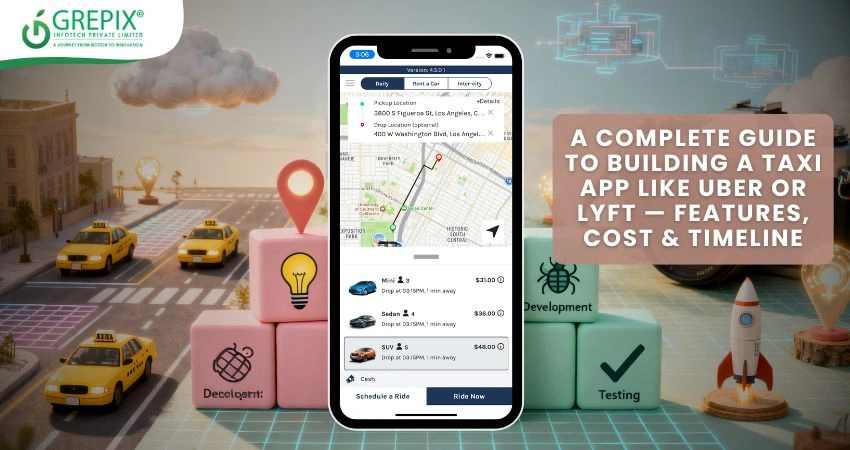
Complete Guide to Building a Taxi App Like Uber or Lyft Features, Cost & Timeline
The ride-hailing market is projected to reach over $229 billion globally by 2030, making digital taxi apps a critical asset for urban mobility businesses. Major brands like Uber, Lyft, Bolt, and Grab set benchmarks in user experience, scalability, and operational efficiency. But local and niche markets remain open for innovation, especially when platforms embrace new technologies and personalized services. By digitizing traditional taxi operations, you can reach more customers, automate bookings, and optimize revenue streams all while meeting rising consumer expectations.
Building a taxi app like Uber or Lyft requires a strategic blend of technology, user experience, and business acumen. This guide from Grepix Infotech explores the essential steps of the process, covering market research, core app features for passengers and drivers, development costs, optimal technology stacks, and realistic launch timelines. You’ll also learn about trending features, the benefits of custom versus white-label solutions, how to select the right monetization models, and crucial tips for launching and scaling your taxi app in 2025 and beyond
Core Ecosystem of Taxi Apps
Successful ride-hailing apps operate via three crucial components:
- Passenger App: Enables easy ride-booking, fare estimation, payment, and ride tracking.
- Driver App: Allows drivers to accept bookings, navigate, and manage earnings.
- Admin Panel: Controls day-to-day operations—user management, payment flows, analytics, and business growth.
All three modules must communicate seamlessly via secure APIs, real-time geolocation tracking, and optimized workflows for marketplace efficiency.
Step-by-Step Development Process
A tried-and-tested process ensures your taxi app is launched quickly, reliably, and within budget:
Research & Market Validation
Understand your competition, user pain points, regulatory requirements, and operational realities before building. Benchmark top ride-hailing apps in your targeted region for feature gaps and service models.
Define Business Model
Choose from popular approaches:
- Commission-based (Uber-style, earning a fee from rides)
- Subscription (monthly fees for drivers or riders)
- Corporate/Enterprise Fleet (dedicated vehicles for business clients).
Design UX/UI
High-quality user experiences drive adoption and retention. Design must be intuitive, fast, and tailored for Android/iOS devices. Responsive graphics and logical flows are vital.
Develop Core Modules
Build the passenger app, driver app, and backend admin panel using modular architecture for scalability. Start with a Minimum Viable Product (MVP) to launch quickly and collect feedback.
API Integration & Thorough Testing
Integrate third-party APIs for maps (Google Maps, Mapbox), payments (Stripe, Razorpay, PayPal), notifications (Firebase), and more. Rigorous testing ensures app stability and security under real-world scenarios.
Launch MVP & Iterate
Deploy a functional MVP for early market entry. Gather data, analyze feedback, and prioritize improvements for full-scale release.
Scale & Add Features
Add advanced modules like loyalty programs, AI-based route optimization, corporate accounts, and fleet management for future growth.
Must-Have Features in a Taxi App
Your app’s long-term success relies on building the right set of features for each stakeholder group:
| Passenger App Features | Driver App Features | Admin Panel Features |
|---|---|---|
| Easy booking | Instant ride requests | User management |
| Real-time tracking | Route optimization | Fare/surge control |
| Multiple payment options | Earnings dashboard | Analytics and reports |
| Fare estimation | Ratings and feedback | Dispute management |
| Ride history | Availability toggle | Promo codes |
| SOS/emergency button | Ride request notifications | Loyalty programs |
Trending Features:
- AI-based route suggestions for fuel efficiency
- In-app chat for riders and drivers
- Multi-payment options (UPI, crypto, wallets)
- SOS/emergency buttons for safety
Choosing Development Approach: Custom vs White-Label
Custom Development
- Full control over features, branding, and workflows
- Ideal for scaling and long-term uniqueness
- Requires bigger upfront investment and longer timeline
White-Label Solutions
- Fast, affordable deployment
- Suitable for local/regional launches
- Limited customization, possible branding constraints
Hybrid Approach: Start with a white-label base and evolve into a custom solution post-MVP as the business grows a cost-effective way for startups.
Also Read: Road to Riches: How to Build a Billion-Dollar Taxi Business in Saudi Arabia
Taxi App Development from Start to Launch
The development timeline hinges on app complexity, team size, and whether you choose off-the-shelf modules or custom features.
- MVP Launch: Typically takes 3 to 4 months—minimum features, basic UX, essential integrations.
- Mid-Level App: With additional modules and analytics, expect 4 to 6 months for full deployment.
- Full-Scale Platform: Advanced features, admin panels, real-time integrations, and multi-country support require 6 to 12 months.
Project management, Agile sprint cycles, and regular client reviews help keep the process on track, minimize risks, and ensure timely launches.
Benefits of Partnering with Grepix Infotech
- Proven expertise in ride-hailing and transportation app solutions.
- Award-winning quality and top customer satisfaction ratings globally.
- Swift deployment and post-launch support for updates, bug fixes, and ongoing enhancement.
- Flexible engagement models: custom development, white-label solutions, and SaaS options.
- Security, scalability, and compliance with data privacy standards.
Complete Guide to Building a Taxi App Like Uber or Lyft
Why Build a Taxi App?
With cities rapidly adopting digital mobility, ride-hailing apps like Uber and Lyft have revolutionized how people commute. On-demand apps win market share by providing seamless, secure, and convenient transport experiences. For businesses, taxi apps unlock scalable revenue streams and operational efficiencies, making this sector ripe for investment.
Key Factors Before Development
- Target Audience & Market Analysis: Research city/country demand, target rider segments, and benchmark competitors.
- Business Model: Choose between commission, subscription, corporate fleet, or franchise-based models.
- Platform Choice: Decide whether to build for iOS, Android, or both. Native apps perform best, but cross-platform frameworks (like Flutter or React Native) can reduce costs and timelines.
Must-Have Features of a Taxi App
Successful ride-hailing apps comprise three core components: Rider App, Driver App, and Admin Panel.
Rider App Features
- Quick registration/login (social/email/OTP)
- Real-time ride booking & fare estimator
- Live vehicle tracking with geolocation
- Multiple payment options: card, wallet, UPI, cash
- Ride history, driver profiles, and saved locations
- Ratings, reviews, and SOS button for safety
- Push notifications and ride receipts
Driver App Features
- Effortless onboarding: KYC, background verification
- Trip requests with pickup/drop info
- Route optimization via GPS/maps
- Earnings dashboard & trip analytics
- In-app chat/call with riders for coordination
- In-app navigation and trip history
Admin Panel Features
- Real-time dashboard for ride/driver analytics
- User, driver, and fleet management
- Fare/rate management and surge pricing
- Payment gateway & commission tracking
- Complaint resolution and support tools
- Sales reports, marketing tools, and promotion setup
Optional Advanced Features
- AI-powered route optimization
- Fleet tracking and analytics for operators
- Multi-language and multi-currency support
- Loyalty programs, promo codes, and discount management
- Integration with third-party services (maps, payment gateways)
- Subscription plans or driver marketplace modules
Step-by-Step Development Process
- Research & Discovery: Define business objectives, analyze competitors, and validate your app concept.
- Planning & Prototyping: Map user flows, create wireframes, and finalize feature lists. Use design tools like Figma or Adobe XD.
- UI/UX Design: Build intuitive interfaces for fast ride booking, navigation, and driver management.
- Development: Use Agile methodology. Develop the Rider app, Driver app, and Admin Dashboard in sprints, starting with MVP.
- API Integration: Add map, payment, notification, and third-party APIs for a seamless experience.
- Quality Assurance: Conduct functional, usability, and performance testing across iOS/Android devices.
- Launch & Feedback: Release MVP, gather user feedback, and iterate for future releases.
- Ongoing Support: Plan for maintenance, feature upgrades, and customer support scaling.
Conclusion
Launching a taxi app like Uber or Lyft is both a challenging and rewarding digital venture. Success hinges on blending technology, intuitive design, and industry expertise to deliver secure, seamless commuting experiences. Meticulous attention to features, user experience, and scalability is a must. Choosing a trusted mobile app development company like Grepix Infotech gives you the innovative edge to enter and lead the competitive ride-hailing apps market in 2025 and beyond.
Partner with Grepix Infotech for end-to-end mobile app development that transforms your vision into a profitable, future-ready on-demand business from concept to ongoing support, at every step.
FAQs
1. How long does it take to launch a ride-hailing app?
Timelines range from 2–4 months for basic products to over 9 months for enterprise-grade, AI-powered platforms.
2. Can I integrate custom features for my taxi app?
Yes! Advanced features like AI dispatch, in-app chat, loyalty programs, multiple payment options, or regional language support can all be tailored to your business model.
3. What is the best tech stack for a taxi app?
Cross-platform frameworks (Flutter/React Native), NodeJs/Laravel backend, Google Maps API, and secure payment gateways (Stripe/PayPal/Razorpay) are popular for robust ride-hailing app development.
4. Is it better to outsource taxi app development?
Partnering with an expert mobile app development company like Grepix Infotech ensures faster delivery, cost savings, and industry best practices critical for launching a high-quality app.
5. Do you provide maintenance and future upgrades post-launch?
Yes. Reliable companies offer continuous support, bug fixing, feature enhancements, and infrastructure scaling as your user base grows.