
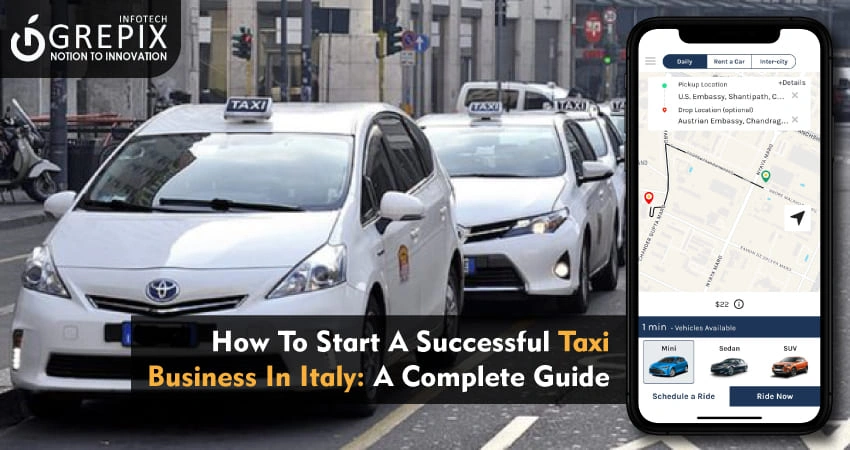
How To Start A Successful Taxi Business In Italy: A Complete Guide
Establishing a taxi business in Italy can be a lucrative endeavor because of the nation's thriving tourism sector and its congested cities, which necessitate adaptable transportation options. We'll go over the necessary procedures for starting a profitable taxi company in Italy in this guide, which includes information on marketing, operational strategies, business planning, and legal requirements.
First, especially in urban areas or tourist-heavy areas, conduct market research to understand customer needs, analyze competition, and determine demand. Select a business structure, like a limited liability company or sole proprietorship, and register your enterprise with the nearby Camera di Commercio. Create a competitive pricing plan and employ courteous, capable drivers. Using digital marketing, building a strong brand, and making your website more search engine friendly for local searches are all effective ways to market your company. Lastly, as your company expands, think about growing and diversifying while still seeking client input to improve your offerings.
Starting a taxi business in Italy can be highly profitable due to its extensive public transportation network and the significant role taxis play, especially in tourist-centric cities like Rome and Milan. This comprehensive guide outlines the key steps to establishing a successful taxi operation in Italy, from understanding the transport landscape to detailed business planning and execution. Begin by conducting in-depth market research to identify demand, analyze competition, and understand your potential customer base in urban or tourist-heavy areas. Legally, securing a licenza taxi is paramount, alongside registering your business appropriately. Choose your fleet carefully to meet local standards and equip them with necessary technology like GPS and payment systems. Implement a competitive pricing strategy and ensure your drivers are well-trained and customer-oriented. Marketing your business effectively through digital channels, building a strong brand, and optimizing for local SEO will help you attract and retain customers. Engage with customer feedback to continually refine your service. With the right approach, your taxi business can thrive in Italy's dynamic transportation sector.
Understanding the Italian Transport Sector
Understanding Italy's public transportation system is crucial before entering the taxi industry. Italy boasts a sophisticated public transportation system that includes trains, buses, and trams. But taxis are important, particularly in tourist-heavy cities like Venice, Rome, Milan, and Florence.
Italy welcomes well over 50 million international visitors annually, and a large share of that traffic funnels through airports, train stations, and historic city centers where taxis remain the default option for last-mile transport. Many Italian cities also restrict private vehicle access in historic centers through ZTL (Zona a Traffico Limitato) zones, which indirectly boosts demand for licensed taxis that are permitted to operate where private cars cannot.
Is a taxi business actually profitable in Italy?
Generally, yes particularly in cities with heavy tourist footfall and limited-traffic zones. Licensed taxis benefit from access to restricted historic centers, dedicated taxi ranks at airports and stations, and street-hailing rights that ride-hailing drivers don't have in many Italian cities. Profitability tends to come down to how well an operator combines these legal advantages with efficient dispatch and consistent vehicle utilization.
Step 1: Market Research
i) Conducting Thorough Market Research
Investigate the needs of the local market first. Determine which cities have a high taxi demand and be aware of the busiest times of day as well as important sites like airports, train stations, hotels, and tourist attractions. Examine the competition, taking note of the number of taxi companies operating in your preferred location and the services they provide.
ii) Understanding Your Audience
Recognize the potential customers you may serve. Are most of them visitors to businesses, residents, or tourists? Different expectations and needs may apply to each group, such as the need for luxury cars or drivers who speak multiple languages.
Before committing to a specific setup, it's worth comparing the main business models available to new operators in Italy. Each comes with a different cost profile and growth potential:
| Model | Typical Setup Cost | Regulatory Load | Growth Ceiling |
|---|---|---|---|
| Licensed Taxi (licenza taxi) | High (license + vehicle) | Heavy | Moderate, but stable |
| App-Based Fleet (own branded app) | Moderate to High | Moderate | High, scalable |
| NCC (Noleggio con Conducente) | Moderate | Lighter, but booking-only | Good for premium/corporate niche |
Figures are illustrative comparisons based on general market patterns, not official statistics. NCC (private hire with driver) cannot pick up street hails, unlike a licensed taxi.
Step 2: Legal Requirements
i) Obtaining Necessary Licenses and Permits
To begin a taxi business in Italy, obtaining the necessary licenses is the most important step. A licenza taxi, or taxi license, is required and is given by the municipality in your area. Cities may have different requirements, but in general, getting this license requires passing an exam on local laws and geography, having a clean criminal record, and going through a medical examination.
ii) Registering Your Business
Register your company with the local Chamber of Commerce, or Camera di Commercio. Selecting a business structure (sole proprietorship, partnership, limited liability company, etc.) and registering for taxes are necessary.
What if there are no taxi licenses available in your city?
This is a common hurdle in cities like Rome and Milan, where municipalities cap the number of taxi licenses and waiting lists can run for years. If that's the case where you want to operate, you generally have three paths: purchase an existing license from a retiring driver (the most common route, though costly), look at smaller cities or provinces with open quotas, or start as an NCC (private hire with driver) operator, which has a separate, often less restrictive, authorization process while you wait for a taxi license to open up.
Also Read: "Essential Guide to the Best Ride-Hailing Apps in Italy"
Step 3: Purchasing and Preparing Vehicles
i) Choosing the Right Vehicles
Choose cars that are economical to maintain, dependable, and comfortable. Sedans make up the majority of taxis in Italy, but smaller vehicles might be better in areas with constrained streets. Make sure the safety and emissions regulations in your area are met by your cars.
ii) Equipping Your Fleet
Give every car the gadgets it needs, like GPS for effective navigation and multiple payment options. Additionally, taxis must have a taximeter installed according to Italian law.
Step 4: Pricing Strategy
i) Setting Competitive Prices
Pricing should be both profitable and competitive. Determine your base fare and kilometer rates by researching what your rivals are charging. Think about offering discounted rates on specific tourist routes or during off-peak times.
To plan realistically, it helps to see where a typical taxi's monthly revenue actually goes. The breakdown below is illustrative, but the proportions are a reasonable starting point for your own financial model:
Illustrative monthly cost breakdown for a single owner-operated taxi in Italy. Actual margins vary by city, fare structure, and hours on the road.
Step 5: Hiring Qualified Staff
i) Recruiting Experienced Drivers
Seeking Out Experienced Drivers employ drivers with solid driving records and local knowledge. As they represent your company, make sure they have strong customer service abilities. If they will be serving tourists, think about providing training to improve their professional skills, such as language classes.
Step 6: Marketing Your Taxi Business
ii) Utilizing Digital Marketing
Create a business website and utilize social media sites to connect with prospective clients. To market your services directly to travelers, think about forming alliances with lodging establishments and travel agencies.
iii) Leveraging Local SEO
Make sure your website is optimized for local search engine rankings. Make sure your company is listed in local directories, encourage happy clients to submit positive reviews, and register your business on Google My Business.
iv) AI-Based Taxi Apps and the Future of the Industry
Beyond basic booking apps, a growing number of taxi operators are adopting AI-powered dispatch and pricing tools. These systems analyze historical demand patterns to predict where riders are likely to need a taxi before the request comes in, reducing empty return trips between fares. Dynamic, demand-based pricing similar to what ride-hailing giants use can also be layered onto an operator's own branded app rather than ceding that pricing power to a third-party platform.
- Predictive dispatching: Positions idle vehicles near zones where demand is expected to spike, such as near major train stations during peak tourist hours
- AI chatbots for bookings: Handle routine reservation requests without tying up phone lines, especially useful for multilingual tourist queries
- Smart route optimization: Continuously recalculates routes using live traffic data, which matters in historic centers with narrow streets and ZTL restrictions
- Personalization: Remembers frequent riders' preferred pickup points, language, and payment method
Looking further ahead, the direction of the industry is converging on three things at once: electrification (driven by tightening emissions rules in historic centers), AI-driven operations, and increasingly personalized rider experiences. Operators who begin adopting even one or two of these now tend to be better positioned than those who wait until competitors force the issue.
Step 7: Launching Operations
i) Soft Launch
To work out any kinks in the operations, think about launching softly at first. Start with a small number of cars and increase the number as you improve your procedures and demand rises.
ii) Customer Feedback
Seek out and analyze client feedback regularly to enhance your offerings. This can assist you in making changes to various areas of your company, such as pricing plans and driver training.
Step 8: Expansion and Diversification
i) Expanding Your Fleet
As your company develops, grow your fleet to accommodate the rising demand. Think about branching out into allied services like private tours for visitors or airport shuttles.
ii) Exploring Technology Integration
Adopt new technologies that can increase the effectiveness of your services, like real-time vehicle tracking systems and booking mobile apps.
iii) Why Is Demand for Taxis Still Growing in Italy?
It can seem counterintuitive that traditional taxis keep growing alongside ride-hailing apps, but a few factors explain it in the Italian context specifically:
- Tourism continues to grow year over year, and visitors unfamiliar with local ride-hailing apps default to taxis at airports and stations out of trust and familiarity.
- Many historic city centers restrict private vehicle access through ZTL zones, which licensed taxis can enter while ordinary private cars and many ride-hailing vehicles cannot.
- An aging resident population in many regions relies more on taxis than on smartphone-first apps.
- Corporate and hospitality partnerships (hotels, event venues) often have standing arrangements with licensed taxi firms rather than individual drivers.
iv) Common Challenges and How to Overcome Them
Most new operators run into a similar handful of obstacles. Recognizing them early makes them easier to plan around:
- High competition from ride-hailing apps: Differentiate through the legal advantages taxis have ZTL access, taxi ranks, and street hailing rather than competing purely on price.
- License scarcity and cost: Budget for this early and consider starting as an NCC operator if a taxi license isn't immediately available in your target city.
- Seasonal tourist demand: Diversify into airport transfers, corporate accounts, and private tours to smooth out revenue across the year, not just peak season.
- Traffic and narrow historic streets: Use route-optimization technology and train drivers on local shortcuts that GPS tools sometimes miss.
Treating these as ongoing habits reviewing pricing against local competitors every few months, renegotiating insurance annually, and revisiting which routes are most profitable as tourist patterns shift seasonally tends to work better than treating them as one-time fixes.
Case Study: Building a Tourist-Focused Fleet in Florence
A small operator in Florence started in 2021 with three vehicles, focused almost entirely on airport and train station transfers booked over the phone. Within three years, the fleet grew to ten vehicles with a mix of standard and multilingual-driver premium rides. A few decisions drove that growth:
- Adopted app-based booking early: Moving off phone-only bookings reduced idle time and let the operator see which pickup zones (train station vs. hotel district) generated the most consistent demand.
- Hired drivers with language skills: English- and French-speaking drivers became a selling point for tour operators and hotels catering to international visitors, supporting a premium rate for those rides.
- Partnered with three boutique hotels: Guaranteed referral arrangements created predictable baseline bookings that softened the drop-off during the slower winter months.
- Tracked monthly performance metrics: Reviewing wait times and booking-to-completion rates surfaced service gaps before they showed up in online reviews.
The fleet more than tripled in three years, funded mainly through reinvested profits rather than outside investment. The pattern echoes what tends to work across Italian tourist cities: a couple of stable B2B partnerships and early technology adoption often matter more to sustained growth than competing purely on per-ride pricing.
Conclusion
Starting a taxi business in Italy is a great opportunity, but it takes careful planning and preparation. Maintaining legal operations and gaining the trust of clients requires making sure that licensing and local regulations are followed. You can establish a strong base for your operations by providing your fleet with vehicles that adhere to safety and environmental regulations as well as the appropriate technology. In a crowded market, your service will stand out with effective marketing and a customer-first mentality. By concentrating on these essential elements: professional staffing, proactive marketing, strategic vehicle selection, market research, and legal compliance. You can establish a successful taxi company that serves both locals and visitors to Italy's energetic cities with efficiency. As your company develops, stay sensitive to shifts in the market and client feedback. Keep coming up with new ideas and ways to enhance your offerings to stay in front of customers and grow your business.
One of the top taxi app development companies, Grepix Infotech, creates ready-to-launch taxi app solutions and is renowned for providing excellent support to individuals looking to launch a taxi business. Like the titans of the industry, Uber and Lyft, many taxi companies highly favor our taxi app because of its robust security features and ease of use. Our feature-rich Uber clone script makes it simple for you to launch your online taxi reservation business. Immediately upon purchase, our hardworking team gets to work customizing the app to your business's branding, including the name and logo, matching the color scheme to your brand, and making sure the branding is maintained throughout.
Our solution is fully customizable, white-labeled, and made to meet the specific needs of both passengers and taxi service providers. The script provides an adaptable web platform that streamlines customer booking and boosts supplier operational efficiency to meet the various demands of the taxi industry. Choose our solution if you want to transform your taxi service using cutting-edge Uber clone software and enter the market quickly and successfully.
Looking out to start your own venture like Uber? Try out our HireMe Taxi Uber Clone, the easiest way to kick-start your taxi business.