
How to Start a Taxi Business in Cameroon: A Step-by-Step Guide
Starting a taxi business in Cameroon is a lucrative and genuinely exciting opportunity, driven by the country& increasing demand for reliable, affordable, and professionally managed transportation services. Whether you are an entrepreneur seeking a new high-growth venture or someone with a passion for the transport industry, launching a taxi business in Cameroon offers a compelling path to sustainable income and long-term business building. With rapidly growing cities like Douala and Yaoundé generating enormous daily commuter demand, the market conditions have never been more favorable for organized, tech-enabled taxi operators who can deliver what informal competitors cannot.
So, how do you get started? This comprehensive step-by-step guide walks you through every critical stage of starting a profitable taxi business in Cameroon from analyzing the market and creating a business plan, through obtaining the necessary legal permits, selecting vehicles, deploying technology, and scaling your fleet sustainably over time.
Starting a taxi business in Cameroon offers a profitable opportunity due to the increasing demand for reliable transportation services. With bustling cities like Douala and Yaoundé as key hubs, entrepreneurs can target diverse customer bases including daily commuters, corporate clients, and tourists. Success requires careful planning, adherence to legal requirements, and choosing fuel-efficient vehicles. Marketing efforts both online and offline are essential for brand visibility, while technology like GPS tracking and cashless payment systems enhance customer satisfaction. Grepix Infotech, a leading taxi app development company, provides tailored solutions to help businesses thrive in Cameroon& dynamic transportation sector.
1 Understanding the Taxi Market in Cameroon
Analyzing the Demand for Taxis in Cameroon
Cameroon& taxi industry is thriving precisely because it fills a critical gap between expensive private car ownership and the discomfort and unreliability of public minibuses and motorbike taxis (motos). Urban commuters increasingly prefer the privacy, safety, and direct routing that taxis provide and as smartphone penetration rises across Douala and Yaoundé, more passengers are ready to book rides digitally and pay via MTN Mobile Money or Orange Money rather than carrying cash. Entrepreneurs who enter the Cameroon taxi market now with professional operations and ride-hailing technology are capturing the emerging middle-class urban commuter segment before the market matures.
Key Cities and Hotspots for Taxi Operations
Douala Cameroon& commercial capital and largest city is the single most important taxi market in the country, driven by its port economy, multinational corporate presence, and massive daily commuter flows between residential neighborhoods like Bonamoussadi and Akwa and the commercial districts of Bali and the Port Zone. Yaoundé, the political capital, generates consistent demand from government ministries, diplomatic missions, and international organizations. Bamenda, Bafoussam, and Garoua represent secondary markets with strong growth potential where professional taxi services are still significantly underdeveloped relative to population demand.
Competition Analysis and Identifying Unique Opportunities
The Cameroon taxi market is dominated by informal, unmetered shared taxis (taxi-brousse and clando) that offer low fares but poor reliability, safety, and passenger experience. This creates a clear opportunity for professional operators who can offer trackable, bookable, cashless-payment taxi services that serve corporate clients, expat communities, hotel guests, and middle-class professionals unwilling to compromise on safety and comfort. Identifying and serving these higher-value segments with a branded taxi app positions your business in a quality niche that informal competitors simply cannot access.
Cameroon Urban Transport Market Segmentation
Source/Insight: Highlighting the major market gap for professional, tech-enabled taxi applications.
2 Creating a Business Plan
Why a Business Plan Is Crucial
A well-structured business plan is the single most important document you will produce before launching your Cameroon taxi business. It acts as your strategic roadmap, defining your goals, target market, competitive positioning, and financial projections with enough precision to guide daily decisions and secure funding from banks or investors who require evidence of serious commercial planning before committing capital to your venture.
Vision and Mission
Define the long-term purpose of your taxi business in concrete, inspiring terms. For example: "To build Douala& most trusted, technology-powered taxi service delivering safe, trackable, cashless transportation to professionals and corporate clients who demand reliability." A clear vision statement aligns your team, attracts quality drivers, and communicates your positioning to corporate clients and investors who evaluate your seriousness as an operator.
Target Audience
Define your primary customer segments with specificity daily corporate commuters in Douala& Akwa and Bonanjo business districts, expats and international NGO staff requiring airport transfers from Douala International Airport, hotel guests needing city tours and business meeting transport, and tourist groups visiting Mount Cameroon and Limbé. Each segment has distinct pricing tolerance, booking behavior, and service expectations that your operational model must address deliberately.
Pricing Strategy
Decide whether your primary pricing model will be distance-based, time-based, or fixed flat rates for specific city routes. For corporate accounts, flat monthly contracts provide revenue predictability for both you and your clients. For individual passengers, transparent upfront fare estimates displayed in your taxi booking app before trip confirmation build trust and eliminate the fare negotiation conflicts that damage informal operator relationships with passengers.
Operational Plans
Detail your fleet management approach, driver shift structures, vehicle maintenance schedules, dispatch methodology (app-based, phone, or both), and how you will handle peak-hour demand surges in Douala& chronically congested traffic environment. Operational plans that account for Cameroon& specific road conditions, fuel supply reliability, and driver market characteristics will be far more realistic and executable than generic templates.
Budgeting for Your Taxi Business
Build a detailed 12-month budget covering vehicle acquisition costs in CFA francs, licensing and registration fees, comprehensive insurance premiums, driver salaries plus statutory social contributions to CNPS (Caisse Nationale de Prévoyance Sociale), fuel reserves, taxi app subscription fees, branding, and marketing. Always allocate a contingency reserve of at least 15% of total monthly operating costs for unexpected vehicle repairs, regulatory compliance changes, or seasonal demand downturns.
3 Legal Requirements for Starting a Taxi Business in Cameroon
Registering Your Business
You must register your taxi business with the Centre de Formalités de Création des Entreprises (CFCE), Cameroon& one-stop business registration center, which handles company name registration, tax identification number (NIU) issuance, and social security registration simultaneously. For most new taxi operators, registering as a SARL (Société à Responsabilité Limitée) or a sole proprietorship depending on your initial scale and investor structure provides the right balance of legal protection and administrative simplicity.
Obtaining Necessary Licenses and Permits
Taxi operations in Cameroon require a transport operator authorization from the Ministry of Transport (Ministère des Transports), specifying your approved service area, vehicle categories, and operating conditions. Each individual vehicle also requires a carte grise commerciale (commercial vehicle registration) and a valid technical inspection certificate (visite technique) renewed annually. Operating without these documents exposes you to fines, vehicle impoundment by gendarmerie checkpoints, and reputational damage with the corporate clients who require fully documented service providers.
Vehicle Requirements and Inspections
All commercial taxis in Cameroon must pass annual technical inspections at SOTRACI (Société de Transformation des Carrosseries et Industries) authorized centers, verifying that brakes, lights, steering, tyres, and safety equipment meet road safety standards. Vehicles must also comply with age restrictions for commercial use set by the Ministry of Transport keeping your fleet relatively modern not only ensures regulatory compliance but also projects the professional image needed to attract corporate clients and hotel partnerships.
Insurance Requirements
Commercial taxi insurance is legally mandatory in Cameroon and must cover third-party liability as a minimum requirement under CIMA (Conférence Interafricaine des Marchés d'Assurance) regulations. Leading insurers operating in Cameroon including Activa Assurances, Chanas Assurances, and NSIA Cameroun offer comprehensive commercial vehicle packages covering own damage, passenger liability, and third-party claims investing in comprehensive cover rather than minimum liability significantly reduces your financial exposure in the event of accidents.
4 Choosing the Right Vehicles
Key Factors to Consider When Purchasing Taxis
When selecting vehicles for your Cameroon taxi fleet, prioritize reliability on roads that include poorly maintained urban streets and occasional unpaved routes between city districts. Fuel efficiency is critical given that fuel represents 35-45% of typical taxi operating costs in Douala. Passenger comfort including functional air-conditioning in Cameroon& tropical climate directly affects your ratings, repeat bookings, and ability to command premium fares from corporate and expat clients who will not compromise on basic comfort standards.
New vs. Used Vehicles Pros and Cons
New vehicles offer manufacturer warranties and the psychological trust advantage of a visibly modern fleet important when pitching corporate contracts. However, the high upfront cost strains startup budgets significantly. Quality used vehicles imported through Douala& busy port from Japan or Europe offer excellent value when purchased from reputable dealers with verifiable service histories and clear customs documentation. Always commission an independent mechanical inspection before finalizing any used vehicle purchase to avoid inheriting hidden faults that generate costly early repairs.
Fuel Efficiency and Maintenance Considerations
Popular taxi models in Cameroon include the Toyota Corolla, Toyota Avensis, Hyundai i20, and Renault Logan all widely available, well-supported by local mechanics, and proven performers in Central African road and climate conditions. Establish relationships with trusted independent mechanics in Douala& auto repair hubs for cost-effective preventive maintenance, and use your fleet management system to track each vehicle& service history, mileage intervals, and upcoming maintenance needs automatically.
| Factor | New Vehicles (Toyota/Hyundai) | Imported Used Vehicles (Japan/Europe) |
|---|---|---|
| Upfront Cost | High initial capital expenditure strain. | Budget-friendly, excellent startup value. |
| Maintenance | Low initial maintenance; manufacturer warranties. | Requires rigorous mechanical verification before buying. |
| Corporate Appeal | Excellent formatting for B2B contracts. | Good if completely branded and well-maintained. |
| Popular Models | Hyundai i20, Renault Logan. | Toyota Corolla, Toyota Avensis. |
5 Setting Up Operations
Hiring Drivers and Staff
The quality of your drivers determines the quality of every passenger experience your taxi business delivers. Seek candidates with valid Cameroonian commercial driver& licenses, clean traffic violation records, strong knowledge of Douala& complex road network including Akwa, Bonaberi, Makepe, and New Bell districts, and verifiably professional attitudes confirmed by previous employer references. Beyond drivers, consider hiring a part-time dispatcher for phone booking management and a part-time accountant once your fleet exceeds five vehicles the operational complexity that justifies dedicated support arrives faster than most new owners expect.
Training and Customer Service
Invest in a structured driver induction program covering professional passenger communication standards in both French and English (reflecting Cameroon& bilingual character), safe defensive driving techniques adapted to Douala& specific traffic conditions, how to operate your taxi booking and dispatch app efficiently, MTN Mobile Money and Orange Money transaction handling, and emergency response protocols. Drivers who receive genuine professional training deliver measurably better passenger ratings that compound into organic word-of-mouth growth across Douala& close-knit professional and expat communities.
Fleet Management Systems
Deploying a dedicated fleet management system is one of the highest-ROI technology investments you can make in your Cameroon taxi operation. Real-time GPS tracking eliminates uncertainty about vehicle locations and enables intelligent nearest-driver dispatch. Automated maintenance alerts prevent the costly breakdowns that leave passengers stranded and damage your reliability reputation. Driver performance monitoring including speed, idle time, and route compliance gives you the data to coach underperformers and reward your best drivers with data-backed objectivity that drivers respect.
Managing Daily Operations
Establish daily operational routines that include pre-shift vehicle safety checks by each driver, real-time booking monitoring through your dispatch dashboard, end-of-shift revenue reconciliation, and a weekly driver team briefing addressing service quality trends, route optimization opportunities, and upcoming maintenance needs. Consistent daily operational discipline is what separates taxi businesses that maintain service quality as they scale from those that see standards erode as fleet size grows.
Daily Taxi Operations Flowchart
6 Marketing Your Taxi Business in Cameroon
Branding Your Taxis
Strong, consistent visual branding is foundational to building a recognizable taxi business in Cameroon& competitive urban markets. Apply professional vehicle wraps in your brand colors with your company name, phone number, and app download link clearly visible. Consistent branding across your entire fleet creates a cumulative visibility effect as your cars circulate through Douala& busiest corridors building passive brand awareness every day without additional advertising spend. Your branded vehicles also signal to corporate clients that you operate a professionally managed business rather than an informal personal service.
Digital Marketing Strategies
Facebook is the dominant social media platform in Cameroon and should be the primary channel for your digital marketing efforts. Create a professional business page, run targeted paid promotions to Douala and Yaoundé-based professionals and expats, and share engaging content including driver spotlights, safety features, special offers, and customer testimonials. WhatsApp Business is equally essential maintain a professional business profile with your service menu, pricing, and instant booking link, and use broadcast lists to reach regular clients with promotions and service updates. Build your Google My Business profile so passengers searching for "taxi Douala" or "airport transfer Yaoundé" find your business prominently.
Offline Marketing Tactics
Distribute professionally printed business cards and flyers at Douala International Airport arrivals, major hotels in Bonanjo and Akwa, expat community centers, and international schools. Place advertisements in English-language Cameroon business publications read by the corporate and diplomatic community that represents your highest-value customer segment. Sponsor local business networking events to build relationships with HR managers and procurement officers at multinationals who hold the keys to lucrative corporate transport contracts.
Leveraging Word-of-Mouth Referrals
In Cameroon& business community particularly among the expat and professional segments that represent your premium revenue base personal recommendations carry extraordinary weight. Formalize this dynamic by building a structured referral program into your taxi booking app: passengers who refer a new client receive a credit or free ride, creating a systematic incentive for your satisfied customers to actively grow your business on your behalf.
Also Read: "Accelerating Your Fortune: Becoming a Billionaire in South Africa& Taxi Industry"
7 Technology in the Taxi Business
Importance of Taxi Apps and Booking Systems
Modern Cameroonian passengers particularly in Douala& growing tech-savvy professional community increasingly expect the ability to book a taxi instantly through a smartphone app, receive a driver ETA in real time, and pay digitally without the friction of cash negotiation. A dedicated taxi booking app is no longer a luxury differentiator in Cameroon& competitive urban transport market it is rapidly becoming the baseline capability that corporate clients and quality-conscious passengers require before considering your service over competitors who already offer it. Grepix Infotech& white-label taxi app solution allows you to launch a fully branded, professional-grade ride-hailing platform tailored for Cameroon& market within weeks.
GPS and Route Optimization
GPS integration in your taxi management platform delivers multiple simultaneous benefits: intelligent dispatch that assigns the nearest available driver to each incoming booking, real-time passenger trip tracking that builds confidence and reduces cancellations, route optimization that navigates around Douala& notorious traffic congestion hotspots on Rue Drouot and the Bonaberi bridge approaches, and driver accountability monitoring that ensures routes are followed efficiently without unauthorized detours that waste fuel and passenger time.
Payment Solutions for Cashless Transactions
Cameroon& mobile money ecosystem is mature and widely adopted MTN Mobile Money and Orange Money together account for the majority of digital transactions in the country. Integrate both platforms as primary payment channels in your taxi app, supplemented by Visa and Mastercard card acceptance for international clients and corporate invoice billing for monthly contract accounts. Cashless payment systems eliminate the driver cash-handling risks and end-of-day revenue discrepancies that create financial management headaches for taxi operators still relying primarily on physical cash collection.
8 Financial Management
Setting Competitive but Profitable Fares
Your fare structure must reflect Douala& specific cost environment fuel prices, driver wages, insurance, and vehicle maintenance costs are all distinct from other African markets while remaining competitively positioned against both informal taxis and any organized operators in your service area. Conduct a realistic cost-per-kilometer analysis for your specific vehicle models and routes before setting fares, and build in sufficient margin to cover your total cost base at average daily trip volumes, not just peak-hour performance. Transparent upfront pricing displayed in your taxi booking app eliminates fare disputes and builds the trust that converts one-time passengers into loyal regular clients.
Managing Operational Costs
Track fuel expenses, routine and corrective maintenance costs, driver salary and CNPS contribution obligations, insurance premium installments, and app subscription fees with disciplined weekly accounting. Identify your highest-cost vehicles and routes early and address inefficiencies through route optimization, preventive maintenance scheduling, and driver coaching on eco-driving techniques. Reducing your cost per trip by even 5-8% through operational discipline can add significantly to your net monthly profit without requiring any increase in trip volume or fares.
Revenue Tracking and Tax Compliance
Maintain accurate, complete records of all income and expenditure for both DGI (Direction Générale des Impôts) tax compliance and internal financial management. File your monthly business tax declarations and annual income tax returns accurately and on time to avoid the DGI penalties that can significantly disrupt your cash flow. Consult with a locally registered Cameroonian accountant familiar with the transport sector& specific tax treatment to optimize your compliance obligations and structure your business finances for maximum efficiency from the outset.
9 Scaling Your Taxi Business in Cameroon
Expanding Your Fleet
Once your initial fleet is generating consistent profit and your operational systems are proven, expand your fleet deliberately by adding vehicles that serve your highest-demand routes and customer segments first. Consider a mix of standard sedans for everyday commuter bookings and one or two higher-specification vehicles such as a Toyota Prado or Toyota Land Cruiser for premium airport transfers and executive bookings that command fares three to four times higher than standard taxi trips. A driver-partner model where owner-operators affiliate their vehicles with your branded taxi app platform enables rapid fleet expansion without the capital cost of purchasing every vehicle yourself.
Entering New Markets in Cameroon
After establishing strong market position in Douala or Yaoundé, consider expansion into secondary cities where organized taxi services are still dramatically undersupplied relative to growing urban populations. Bamenda, Bafoussam, Limbé, and Garoua all present meaningful expansion opportunities your established brand, technology infrastructure, and operational playbook give you decisive advantages over any new local start-up entering those markets at the same time you do.
Partnering with Ride-Hailing Platforms
Selectively partnering with regional ride-hailing platforms to supply driver capacity during peak demand periods can supplement your own branded app bookings during your early growth phase. However, maintain your own branded app as your primary booking channel to preserve direct customer relationships, avoid platform commission costs of 20-25%, and build the proprietary passenger database that represents one of your business& most valuable long-term commercial assets.
10 Challenges and How to Overcome Them
Common Challenges in the Cameroon Taxi Industry
Cameroon& taxi industry presents specific operational challenges that every new operator must prepare for: highly volatile fuel prices driven by international crude oil market fluctuations, vehicle maintenance cost increases caused by CFA franc exchange rate movements for imported spare parts, intense price competition from informal clando operators with minimal overheads, and roads in some urban districts that accelerate vehicle wear rates significantly above standard maintenance estimates.
Strategies to Deal with Competition
Your most effective competitive strategy against informal Cameroon taxi operators is to occupy the quality market segments they cannot access: corporate transport contracts requiring invoicing and verified driver credentials, hotel and hospitality partnerships requiring consistent professional standards, expat community transport where personal safety and predictability are non-negotiable, and technology-literate urban professionals who demand app-based booking and cashless payment as baseline expectations. In these segments, price is a secondary concern reliability, safety, and professional accountability are what win and retain clients.
Managing Economic Fluctuations
Build economic resilience into your Cameroon taxi business through revenue diversification across multiple customer segments and income streams. Corporate contract revenue that remains stable through economic downturns provides the financial floor that individual passenger bookings cannot guarantee. Maintain a three-month operating expense reserve to weather sudden fuel price spikes or regulatory changes without compromising your ability to service loans, pay drivers, or maintain vehicles at the standards your clients expect.
11 Why the Taxi Business Is Booming Across Cameroon
Several converging trends explain why now is an unusually good moment to enter Cameroon& taxi sector. Rapid urbanisation is pulling more residents into Douala and Yaoundé every year, and public transport infrastructure has not kept pace with this growth, leaving a widening gap that organised taxi operators are well placed to fill. At the same time, smartphone and mobile internet adoption keeps climbing across Central Africa, meaning the audience capable of booking a ride through an app rather than flagging one down on the street is larger than it has ever been. Add to this a growing middle class that values time savings and predictable pricing over the lowest possible fare, and the result is a market where demand for dependable, bookable transport is consistently outpacing the supply of operators who can deliver it professionally.
12 Is a Taxi Business in Cameroon Actually Profitable?
Profitability in this industry is rarely about a single magic number it is the outcome of how disciplined you are about costs versus how effectively you fill seats. A single well-maintained sedan running consistent corporate or airport routes in Douala can comfortably cover its fuel, driver pay, and maintenance reserve while still returning a healthy margin once utilisation crosses a certain threshold. The biggest swing factor is idle time: a vehicle sitting unused for long stretches between bookings is the single largest drain on profitability that new operators underestimate. This is precisely why technology matters so much a booking system that keeps your cars moving between fares, rather than waiting for the next passenger to flag them down, is often the difference between a fleet that merely survives and one that compounds profit month after month. Operators who track cost-per-kilometre against revenue-per-kilometre on a weekly basis tend to spot profitability problems and opportunities months before operators relying on end-of-year accounting alone.
13 Comparing Taxi Business Models: Which Fits Cameroon Best?
Not every taxi business looks the same, and the model you choose shapes everything from your startup costs to your daily workload. A fully owner-operated fleet where you purchase every vehicle and employ every driver directly gives you maximum control over service quality and branding, but it also means every cost and every risk sits on your balance sheet alone. At the other end of the spectrum, a driver-partner or aggregator model where independent vehicle owners affiliate with your brand and app in exchange for a share of each fare lets you scale the number of cars on the road far faster than your own capital would otherwise allow, though it requires stronger systems for quality control since you do not directly manage every driver. A hybrid approach, common among successful operators in neighbouring markets, is to keep a small core fleet of company-owned vehicles for premium and corporate bookings while building out a larger partner network for everyday city trips. For most new entrants in Douala or Yaoundé, starting with a small owner-operated core and layering in partner drivers once your booking volume justifies it tends to balance growth speed against the operational discipline needed to protect your reputation.
14 The Future of Taxi Technology: AI, Green Vehicles, and Personalisation
The next phase of growth in taxi technology is being shaped by three forces that are already visible in more mature markets and steadily making their way into Africa& urban transport sector. The first is artificial intelligence applied to dispatch and pricing systems that learn traffic patterns, demand surges around paydays or events, and individual driver performance well enough to match the right vehicle to the right passenger before either has to wait. The second is the gradual arrival of electric and hybrid vehicles into commercial fleets, driven by the simple economics of fuel price volatility; an operator who can run even a portion of their fleet on lower-cost energy gains a real cost advantage that compounds over thousands of trips. The third, and perhaps most underrated, is personalisation apps that remember a regular passenger& preferred pickup points, favourite drivers, or payment method, turning a one-time ride into a habitual choice. Operators who begin building the data foundations for these capabilities now, even on a modest scale, will find it far easier to adopt AI-assisted dispatch and green-fleet planning as those tools mature and become more accessible across Central African markets.
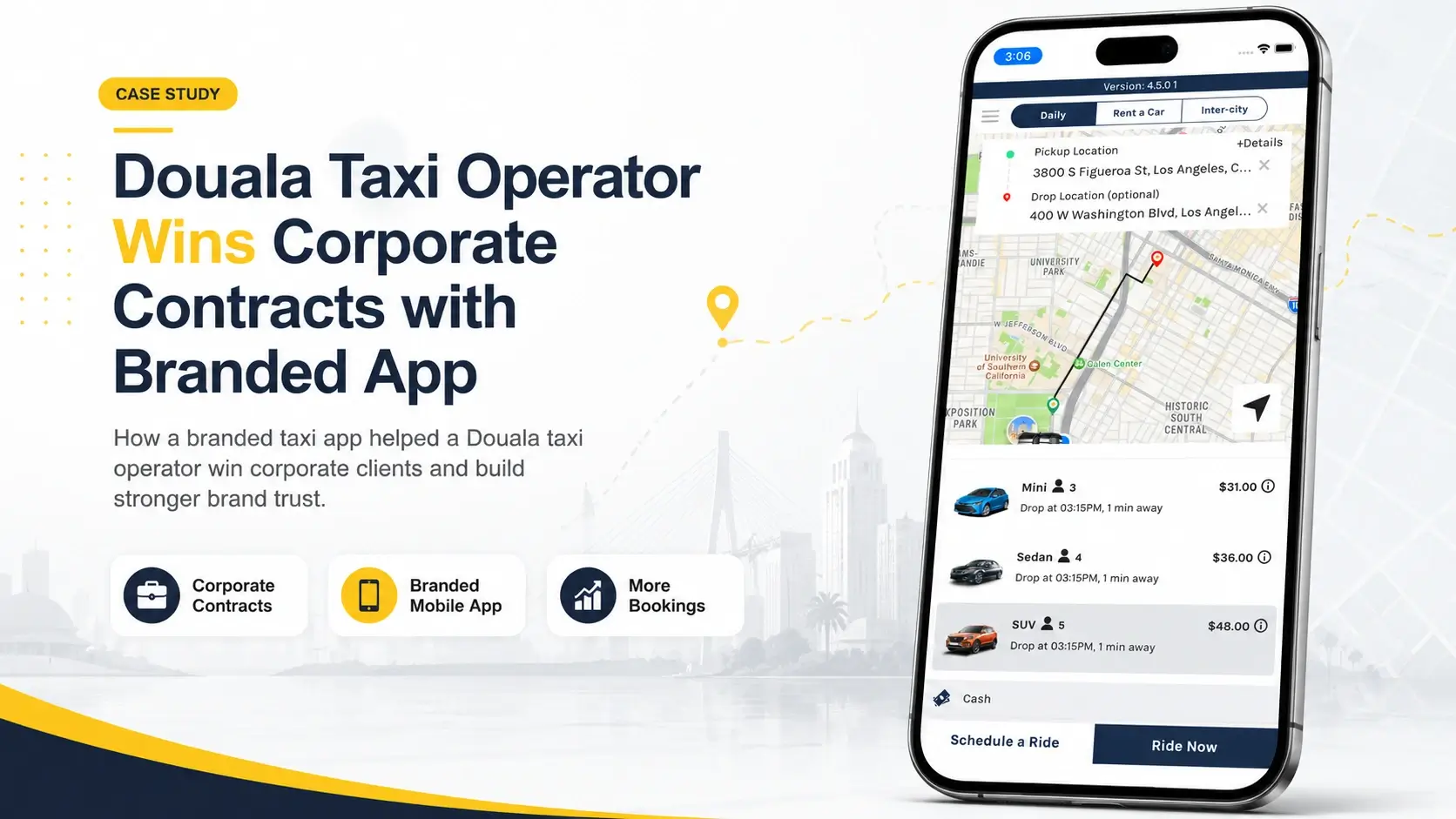
Case Study: Douala Taxi Operator Wins Corporate Contracts with Branded App
Emmanuel K., a former logistics manager with a major Douala trading company, launched his taxi business in 2022 with four Toyota Corolla vehicles serving the Akwa-Bonanjo corporate corridor. Operating initially through WhatsApp booking and cash collection, he struggled to differentiate his service from Douala& many informal operators despite his newer vehicles and professionally trained drivers.
After partnering with Grepix Infotech to deploy a white-label taxi app under his own brand name complete with MTN Mobile Money and Orange Money integration, real-time GPS tracking, and corporate invoicing capability Emmanuel was able to approach Douala& multinational companies with a credible professional service offering backed by verifiable technology. Within three months of app launch, he signed transport contracts with two international NGOs and a French-owned trading house operating in Douala& port zone, adding FCFA 4.2 million in guaranteed monthly revenue.
His fleet grew to 11 vehicles within 14 months, supported by both owned cars and two driver-partners who had affiliated their own vehicles with his platform. Emmanuel& experience demonstrates that in Cameroon& emerging professional taxi market, deploying the right technology platform at the right moment is the single most effective way to leapfrog informal competitors and access the high-value corporate and institutional client segments that deliver sustainable, scalable revenue growth. Contact Grepix Infotech to explore how their solutions can do the same for your business.
Conclusion
Starting a taxi business in Cameroon presents a genuinely lucrative opportunity in a market driven by accelerating urbanization, economic growth in Douala and Yaoundé, and rapidly increasing demand for professional, reliable transportation from both local commuters and the country& significant expat and international business community. Entrepreneurs who approach this market with strategic clarity, full regulatory compliance, strong technology infrastructure, and a relentless focus on service quality are well-positioned to build durable, profitable taxi businesses in one of Central Africa& most dynamic economies.
Grepix Infotech, a leading taxi app development company, provides innovative and tailored ride-hailing technology solutions specifically designed to support taxi businesses across Africa& emerging markets including Cameroon. Their advanced platforms integrate MTN Mobile Money and Orange Money payments, real-time GPS fleet tracking, intelligent dispatch, cashless payment systems, corporate invoicing, and passenger-facing booking apps that enable businesses to deliver seamless customer experiences from day one of operations.
With Grepix Infotech as your technology partner, you can navigate Cameroon& competitive challenges, streamline your fleet operations, win corporate accounts, and position your taxi business for long-term sustainable success. Contact Grepix Infotech today to begin building the taxi business that Cameroon& passengers are waiting for.
FAQs
1. What is the cost of starting a taxi business in Cameroon?
Starting with one vehicle typically costs between FCFA 5 million and FCFA 12 million covering vehicle purchase, commercial registration, insurance, branding, and initial marketing. A small fleet of three to five vehicles with a taxi booking app requires approximately FCFA 20 to 40 million in total startup capital depending on vehicle age and specifications chosen.
2. What licenses do I need for a taxi business in Cameroon?
You need a business registration from the CFCE, a transport operator authorization from the Ministry of Transport, a carte grise commerciale for each vehicle, an annual visite technique (roadworthiness certificate), and CIMA-compliant commercial vehicle insurance covering passengers and third-party liability. Each driver must also hold a valid Cameroonian commercial driver& license.
3. Can I start a taxi business in Cameroon with one car?
Yes. Starting with a single fully compliant vehicle allows you to test your service model, build initial customer relationships, and generate proof-of-concept revenue with minimal capital risk. Reinvest your profits consistently and use a white-label taxi app from day one to position your business professionally and attract corporate clients even at this early stage.
4. How do I handle competition from informal clando taxis in Cameroon?
Target the quality customer segments that informal operators cannot access corporate transport contracts, hotel partnerships, expat community transport, and tech-savvy professionals who demand app-based booking and cashless MTN Mobile Money payments. These segments prioritize safety, reliability, and accountability over lowest price, placing you in a completely different competitive arena from informal clando services.
5. What are the common challenges faced by taxi businesses in Cameroon?
Key challenges include volatile fuel prices, vehicle maintenance costs elevated by imported spare parts, intense price competition from informal operators, Douala& severe traffic congestion during peak hours, and the need to manage bilingual (French and English) customer communications. Effective fleet management technology, fuel cost monitoring, and a strong corporate account base that provides stable revenue through economic fluctuations are the most effective responses to each of these challenges.
6. What digital payment methods should my Cameroon taxi service accept?
MTN Mobile Money and Orange Money are the two essential payment channels for any Cameroon taxi business together they cover the vast majority of your potential passenger base. Additionally offer Visa and Mastercard card acceptance for international clients and corporate invoice billing on 30-day terms for monthly contract accounts. Integrating all payment options through your taxi app creates seamless, frictionless transactions that passengers remember positively and talk about to colleagues.
7. Do I need a taxi app to run a taxi business in Cameroon?
While not legally required, a dedicated taxi booking app is rapidly becoming the practical baseline for any serious Cameroon taxi operator targeting corporate clients and quality-conscious passengers. Grepix Infotech offers affordable white-label taxi app solutions with MTN Mobile Money integration, real-time GPS tracking, and automated dispatch that can be deployed under your own brand within weeks giving you technology-level parity with much larger operators at a fraction of custom development cost.
8. What are the best vehicles for a taxi business in Douala?
Toyota Corolla, Toyota Avensis, Hyundai i20, and Renault Logan are among the most popular and practical choices all widely available as used imports through Douala port, well-supported by local mechanics, fuel-efficient in city driving, and reliable on the varied road surfaces found across Douala& diverse urban districts. For premium airport and executive segments, a Toyota Prado or Land Cruiser delivers the status and comfort that high-fare clients expect.
9. Is a taxi business profitable in Cameroon?
Yes, when run with disciplined cost tracking and high vehicle utilisation. The biggest factor separating profitable operators from struggling ones is idle time vehicles that sit between bookings instead of being matched to new fares quickly. A booking and dispatch app that keeps cars moving, combined with weekly cost-per-kilometre tracking, is one of the simplest ways new operators improve their margins within the first few months.
Looking out to start your own venture like Bolt? Try out our HireMe Taxi Bolt Clone, the easiest way to kick-start your taxi business.