

How to Start a Taxi Business in Uganda: A Comprehensive Guide
Starting a taxi business in Uganda offers a lucrative opportunity to tap into the ever-growing demand for transportation. With urbanization and a thriving tourism sector, people constantly require reliable transport solutions. However, establishing a successful taxi business requires careful planning, compliance with regulations, and strategic execution.
Launching a taxi business in Uganda is an excellent opportunity to meet the transportation needs of a growing population while earning substantial profits. By understanding the market, complying with regulations, maintaining reliable vehicles, and prioritizing customer satisfaction, you can establish a successful and sustainable business. Remember, consistency and adaptability are key in navigating challenges and scaling your operations.
Here’s a comprehensive guide to help you navigate the process.
Starting a taxi business in Uganda presents a lucrative opportunity to meet the growing transportation demand fueled by urbanization and a thriving tourism sector. Success in this venture requires thorough market research, compliance with licensing and regulations, and strategic planning. Crafting a detailed business plan, investing in reliable vehicles, recruiting skilled drivers, and leveraging technology like ride-hailing apps are essential steps. Strong branding, effective marketing, and excellent customer service further enhance your competitiveness. With careful execution and adaptability, you can establish a sustainable and profitable taxi business, capitalizing on dynamic and evolving transportation needs in Uganda.
1Understanding the Market and Crafting a Business Plan
Researching the Taxi Market in Uganda
Before diving into the taxi business, conducting thorough market research is essential. Understand the transportation needs in different cities, including Kampala, Entebbe, and Jinja. Assess the competition from existing players like Uganda's leading ride-sharing and taxi apps, popular routes, and prevailing pricing strategies. Is there a demand for ride-hailing services, airport transfers, corporate taxi solutions Uganda, or long-distance intercity trips? Identify underserved corridors - for instance, late-night transport in Wakiso District or hospital shuttle services in Gulu - where targeted taxi services can capture loyal customers quickly. A clear picture of market gaps will sharpen your business direction and reduce time-to-profitability.
Equally important is understanding your target customer segments: daily office commuters, university students, tourists visiting Bwindi or the source of the Nile, and business executives requiring premium chauffeured rides. Each segment has different price sensitivity and service expectations, and your taxi business in Uganda should position itself to serve at least two segments from day one.
Creating a Detailed Business Plan
Your business plan serves as the strategic roadmap for your taxi company setup. Outline the nature of your service - whether you’ll operate regular metered taxis, boda-boda motorbike taxis, shared minibus taxis (matatus), or a fully digital ride-hailing platform. Include detailed financial projections covering vehicle acquisition costs, fuel budgets, driver salaries, insurance premiums, and technology expenditure. Set clear revenue goals and break-even timelines. A robust, investor-ready plan will also help you secure funding from banks, Uganda Development Bank (UDB) loans, or angel investors interested in transportation solutions Uganda. Attach a competitive analysis showing how your positioning differs from Uber Uganda, Bolt, or local operators like SafeBoda.
2 Legal Requirements and Licensing
Registering Your Business
To operate legally in Uganda's taxi industry, register your business with the Uganda Registration Services Bureau (URSB). Choose an appropriate business structure - a sole proprietorship works for small single-vehicle operators, while a limited liability company (LLC) offers better protection as you scale your taxi fleet. Obtain a Taxpayer Identification Number (TIN) from the Uganda Revenue Authority (URA) and ensure you are registered for Value Added Tax (VAT) if your annual turnover exceeds UGX 150 million. Proper business registration also builds credibility with corporate clients and ride-hailing platform partners.
Obtaining Necessary Licenses
Vehicle licensing Uganda is non-negotiable in the taxi industry. Secure an operator’s license from the Ministry of Works and Transport, and ensure each vehicle carries a valid Public Service Vehicle (PSV) permit. Commercial taxis must undergo roadworthiness inspections at authorized Uganda National Bureau of Standards (UNBS) testing centres. Ensure all vehicles carry comprehensive insurance as well as third-party liability coverage to protect passengers, drivers, and third parties in the event of an accident. Keep all licensing documents current - expired permits are a leading cause of police impoundment and operational disruption for taxi businesses in Uganda.
Complying with Local Regulations
Different districts and municipalities have unique transport guidelines that apply specifically to your service area. The Kampala Capital City Authority (KCCA) has its own permit systems for public service vehicles (PSVs) operating within the city, including designated taxi parks at Old Taxi Park and New Taxi Park. If you intend to service Entebbe International Airport, comply with Uganda Airports Authority (UAA) ground transport rules and obtain an airport operator badge. Familiarize yourself with local rules, traffic ordinances, and road-use charges to avoid legal trouble, fines, or fleet seizure.
3 Acquiring and Equipping Your Vehicles
Choosing the Right Vehicles
The type of vehicle you choose will directly determine your operating costs and customer experience. For urban commutes in Kampala, smaller fuel-efficient cars like the Toyota Corolla, Premio, or Wish are economical and easy to maneuver in traffic. For airport transfers and corporate taxi solutions Uganda, consider comfortable saloons or SUVs such as the Toyota Prado or Land Cruiser. For intercity and long-distance travel, minivans like the Toyota Hiace offer the capacity to transport groups cost-effectively. When building your fleet, prioritize vehicles that balance durability, fuel efficiency, and maintenance affordability - key factors in keeping your fleet management Uganda costs under control. Consider sourcing vehicles through reputable dealers with service warranties to reduce downtime.
Customizing and Branding
Equip every taxi in your fleet with GPS tracking devices, air conditioning, digital fare meters, and dashcams for safety and accountability. Offering free Wi-Fi as a standard feature immediately differentiates your service from unbranded competitors. Brand your vehicles with a consistent, professionally designed logo, company colors, and contact details - this acts as 24/7 mobile advertising across Kampala's streets. Additionally, provide drivers with branded uniforms to project a cohesive, professional company image that builds passenger trust. Branded vehicles also make it easier for your taxi app Uganda passengers to identify their ride at pickup points.
4 Recruiting and Training Drivers
Hiring Competent Drivers
Drivers are the face of your taxi business - their conduct directly shapes your brand reputation. Hire individuals with valid Ugandan Class B or above driver’s licenses, clean driving records, and extensive experience navigating Ugandan roads including high-traffic areas like Kampala Ring Road and Jinja Highway. Conduct thorough background checks via Uganda Police’s Certificate of Good Conduct to ensure reliability and trustworthiness. For premium or airport transfer services, prioritize drivers with professional chauffeur experience who can represent your brand to corporate clients and international tourists. Establish a clear driver code of conduct that aligns with your customer-focused taxi services standards.
Providing Professional Training
Invest in structured driver training programs covering customer service excellence, defensive driving techniques, Uganda Highway Code compliance, and emergency response procedures. Teach drivers how to use your taxi app platform efficiently - accepting bookings, navigating to pickup points, and managing in-app payments. Emphasize soft skills such as communication, courtesy, and conflict resolution to create consistently positive passenger experiences. Well-trained drivers reduce accident rates, improve customer ratings, and lower your insurance premiums over time - a direct return on your training investment.
5 Setting Up Technology for Operations
Implementing Ride-Hailing Platforms
Technology can fundamentally transform your taxi business from a locally known operator into a scalable, data-driven enterprise. You have two main paths: partner with established ride-hailing apps Uganda such as Uber, Bolt, or SafeBoda, or build your own branded on-demand taxi app. Partnering provides instant access to a customer base but ties you to commission fees (typically 20–25%). Owning your branded app gives you full control over pricing, customer data, driver relationships, and long-term profitability. Grepix Infotech, a leading taxi app development company, specializes in building white-label ride-hailing apps tailored to emerging markets like Uganda - complete with real-time tracking, multi-language support, and offline booking capabilities that work even on low-bandwidth networks.
Key features your taxi app Uganda should include: real-time driver tracking, in-app chat, fare estimator, ride scheduling, SOS emergency button, driver rating system, and multi-currency payment support. These features make your platform competitive with global ride-hailing standards while meeting the specific needs of Ugandan commuters.
Integrating Payment Solutions
Cashless payments are increasingly the preferred choice among Ugandan urban commuters, particularly among the tech-savvy younger demographic. Equip your taxis with seamless integrations for MTN Mobile Money and Airtel Money - Uganda's two dominant mobile payment platforms covering over 20 million active subscribers. For corporate accounts and international tourists, accept Visa and Mastercard payments via POS terminals or in-app card processing. Offering a diverse range of payment options reduces fare disputes, eliminates cash theft risks for drivers, and provides transparent transaction records for your accounting and tax compliance with the Uganda Revenue Authority.

6 Marketing and Branding Your Taxi Business
Developing a Strong Brand Identity
A recognizable, trusted brand sets you apart in Uganda's competitive taxi industry. Create a memorable company name, professionally designed logo, and a clear service promise (e.g., "Safe, Reliable, On-Time") that resonates with your target audience. Consistent branding across vehicles, driver uniforms, your taxi app, and all promotional materials builds passenger trust and credibility. Consider colors that stand out on Kampala's roads - yellow and green combinations are proven high-visibility choices for taxi company Uganda fleets. Register your brand as a trademark with the Uganda Registration Services Bureau to protect your identity as you grow.
Utilizing Digital Marketing
In today’s mobile-first Uganda, a strong online presence is indispensable for any serious taxi service Uganda operator. Build a professional website optimized for local SEO - target keywords like "taxi in Kampala," "airport transfer Uganda," and "hire taxi Entebbe" to capture high-intent search traffic. Leverage social media platforms like Facebook (dominant in Uganda), Instagram, WhatsApp Business, and TikTok to engage customers, run targeted ride promotions, and showcase driver stories. Partner with travel bloggers and Ugandan lifestyle influencers to extend your reach to the lucrative tourist segment. Run Google Ads targeting Kampala and airport corridor searches for immediate lead generation.
Engaging in Community Outreach
Building trust within local communities is a long-term investment that pays significant dividends in customer loyalty. Sponsor local events in Kampala, Wakiso, or Mukono, provide discounted rides for school runs or hospital visits, or offer free rides for elderly passengers as part of your corporate social responsibility (CSR) program. Partner with NGOs and healthcare organizations for medical transport contracts - a reliable revenue stream independent of consumer ride-hailing volatility. Such community initiatives boost goodwill, generate organic word-of-mouth referrals, and attract loyal customers who actively advocate for your customer-focused taxi services.
7 Ensuring Efficient Fleet Management
Implementing Fleet Management Systems
Effective fleet management Uganda requires robust technology and operational discipline. Invest in GPS-powered fleet management software to monitor vehicle locations in real-time, track fuel consumption, analyze driver behavior (speeding, harsh braking, idling), and generate automated mileage reports. Leading platforms like Samsara, FleetComplete, or locally integrated solutions can save fuel costs by 15–20% through route optimization alone. Set up automated alerts for maintenance due dates, license renewals, and insurance expiry so your compliance team never misses a critical deadline. For larger fleets, assign a dedicated fleet manager responsible for daily dispatch coordination, driver scheduling, and incident reporting - a role that quickly pays for itself in reduced downtime.
Scheduling Regular Maintenance
Preventative vehicle maintenance is the backbone of a reliable taxi business Uganda. Establish a strict service schedule covering engine oil changes every 5,000 km, brake inspections every 10,000 km, tire rotation and alignment every 15,000 km, and full drivetrain checks annually. Partner with a reliable mechanic workshop in Kampala - ideally one with experience servicing Toyota fleets - and negotiate bulk service rates to reduce per-vehicle maintenance costs. Maintain a digital maintenance log for each vehicle using your fleet management system so audit trails are always available for insurance claims and regulatory inspections. A well-maintained fleet means fewer breakdowns, fewer stranded passengers, and a stronger brand reputation for punctuality and reliability.
Also Read: "Accelerating Your Fortune: Becoming a Billionaire in South Africa's Taxi Industry"
8 Providing Excellent Customer Service
Focusing on Customer Satisfaction
Happy, loyal customers are your most valuable marketing asset in Uganda's word-of-mouth driven market. Train every driver to be consistently polite, punctual, and knowledgeable about routes across Kampala, Wakiso, and beyond. Implement a 5-star rating system within your taxi app Uganda so passengers can rate every ride - this creates accountability and surfaces underperforming drivers before they damage your brand. Set up a dedicated customer support WhatsApp line and in-app help centre to address complaints within two hours. Regularly analyze low-rated trips and run targeted coaching sessions. A Net Promoter Score (NPS) above 70 is a realistic target for a customer-focused taxi service Uganda within the first year of operations.
Offering Unique Services
Differentiate your taxi business with value-added services that justify a modest price premium. Standard upgrades that Uganda passengers appreciate include: free in-vehicle Wi-Fi (using a Smile or MTN 4G router), phone charging ports, bottled water for airport transfers, and child car seats on request. Launch a loyalty points program where frequent riders earn free rides after a set number of trips - a proven retention mechanism used by global ride-hailing apps Uganda. For corporate clients, offer monthly invoicing accounts with consolidated reporting. For tourists, bundle guided city tour packages with your taxi booking. These small touches dramatically reduce churn and increase average lifetime customer value for your taxi company Uganda.
9 Scaling Your Taxi Business
Expanding Your Fleet
Once your taxi business Uganda gains traction and consistent cash flow, systematic fleet expansion is the most direct path to revenue growth. Analyze your ride data - which routes, time slots, and pickup zones generate the highest demand and profit margins - and deploy additional vehicles precisely where supply is insufficient. Use your fleet management Uganda software to model the incremental revenue and payback period of each new vehicle before committing capital. Explore vehicle financing options through Stanbic Bank Uganda, dfcu Bank, or ABSA Uganda's SME fleet loan products. Collaborating with owner-operators (drivers who own their vehicles but operate under your brand and app) is an asset-light model that lets you grow your service footprint without proportional capital investment.
Entering New Markets
Uganda offers significant untapped opportunities outside Kampala. Secondary cities like Gulu, Lira, Masaka, Fort Portal, and Mbale have growing middle-class populations with limited formal taxi service Uganda options. Research local transport needs, price sensitivity, and mobile money penetration before entering each new market. Adjust your vehicle type, pricing tiers, and service hours to match regional demand patterns. Intercity transport between Kampala and Mbarara or Kampala and Jinja is a high-revenue corridor currently dominated by informal operators - a structured, app-booked taxi service here can command a significant premium for reliability and safety.
Introducing Premium Services
A premium service tier is a high-margin growth lever for your taxi business Uganda. Launch a "Black Car" or "Executive" category within your taxi app featuring luxury vehicles (Mercedes E-Class, Toyota Prado, or Land Cruiser), professionally uniformed chauffeurs, and complimentary amenities. Target business travelers, government officials, embassies, and international tourists visiting Uganda's national parks and gorilla trekking destinations - segments that prioritize comfort over cost. Corporate retainer contracts with multinationals operating in Kampala (Tullow Oil, MTN Uganda, Airtel Uganda) can deliver predictable monthly recurring revenue that stabilizes your business against consumer ride-hailing seasonality.
10 Challenges and How to Overcome Them
Managing Competition
Competition in Uganda's taxi industry is intensifying as Uber, Bolt, SafeBoda, and multiple local operators fight for the same urban commuter base. Stay ahead by continuously innovating your service offering, maintaining competitive and transparent pricing, and staying current with ride-hailing apps Uganda market trends. The most durable competitive advantage is one that is difficult to replicate: a trusted brand, a large pool of highly rated drivers, proprietary customer data, and a purpose-built taxi app development Uganda platform. Regularly mystery-shop competitor services to benchmark your punctuality, vehicle quality, and driver professionalism. Compete on total customer experience, not just price - price wars erode margins for everyone in the market.
Navigating Regulatory Changes
Uganda's transport regulatory environment is evolving rapidly as the government responds to ride-hailing growth, road safety concerns, and tax compliance gaps. The Ministry of Works and Transport, KCCA, and Uganda Revenue Authority periodically update PSV regulations, driver certification requirements, and digital platform taxation rules. Subscribe to KCCA and Ministry of Works communications, join the Uganda Taxi Operators and Drivers Association (UTODA), and engage a local transport law consultant to stay ahead of regulatory changes. Proactive compliance protects your taxi company Uganda from fines, fleet seizures, and the reputational damage of operating illegally.
Handling Rising Costs
Fuel prices, vehicle maintenance expenses, and driver wages are the three largest variable cost drivers for any taxi business in Uganda. Mitigate fuel cost volatility by investing in fuel-efficient hybrid vehicles where budget allows, using GPS route optimization to reduce unnecessary mileage, and negotiating bulk fuel purchase agreements with Total Energies or Shell Uganda. For maintenance, negotiate fixed-fee service contracts with garage partners to convert unpredictable repair costs into manageable monthly expenses. Structure driver compensation with a base-plus-commission model that aligns driver incentives with business profitability while remaining competitive enough to retain top talent in Uganda's increasingly competitive ride-hailing driver market.
11 Tracking Success and Improving
Monitoring Key Performance Indicators (KPIs)
Data-driven management is what separates thriving taxi businesses Uganda from those that stagnate. Track a dashboard of core KPIs weekly: total rides completed, gross revenue, average fare per ride, driver utilization rate (active hours vs. available hours), ride acceptance rate, trip cancellation rate, customer acquisition cost (CAC), and monthly active users on your taxi app Uganda. Customer retention rate - the percentage of passengers who book again within 30 days - is your single most important growth metric. Use your ride-hailing platform's analytics dashboard to generate automated weekly reports and set KPI targets with accountability for each operations team member.
Collecting Customer Feedback
In Uganda's relationship-driven market, acting on customer feedback visibly and promptly is a powerful trust-builder. Use in-app post-ride surveys, Google Business Reviews, and Facebook ratings to systematically gather passenger insights about your customer-focused taxi services. Analyze feedback themes monthly - recurring complaints about wait times, vehicle cleanliness, or driver behavior signal operational gaps that need immediate attention. Implement a closed-loop feedback process where customers who leave 3-star-or-below reviews are personally followed up by a customer experience team member within 24 hours. Public responses to negative Google Reviews demonstrate accountability and often convert dissatisfied passengers back into loyal advocates for your taxi service Uganda.
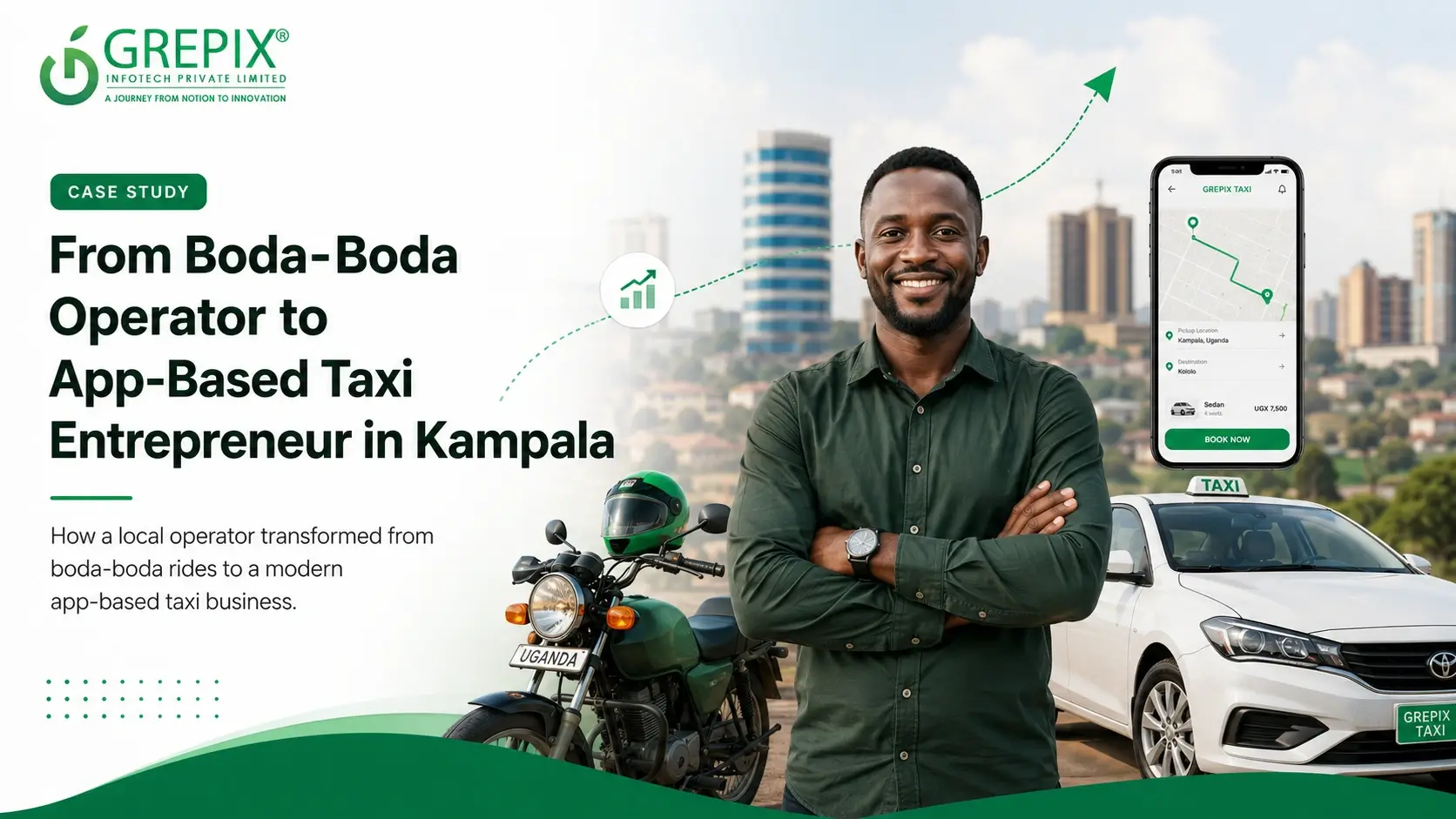
Case Study: From Boda-Boda Operator to App-Based Taxi Entrepreneur in Kampala
To illustrate the real-world potential of building a branded taxi app in Uganda, consider the journey of James, a Kampala-based transport entrepreneur who started with three secondhand Toyota Corollas serving the Entebbe Airport corridor.
The Challenge
James had solid relationships with regular corporate clients but was losing bookings to Uber and Bolt because he couldn't offer real-time tracking or digital payment options. His drivers used WhatsApp for bookings - a system that broke down during peak hours and left customers frustrated with no visibility on driver location or estimated arrival times. He needed a professional, branded taxi app Uganda but assumed it was financially out of reach for a small operator.
The Solution
James partnered with Grepix Infotech to deploy a fully white-label ride-hailing app under his own brand. The platform included a passenger app (available on Android, which dominates the Ugandan smartphone market), a driver app with real-time navigation, and an admin dashboard for managing dispatch and fleet performance. Crucially, the payment module was integrated with MTN Mobile Money and Airtel Money Uganda's dominant cashless payment rails - alongside Visa/Mastercard for international clients.
The Results
- Launch Timeline: The branded app went live in under 4 weeks - far faster than James anticipated.
- Corporate Client Retention: All three of his existing corporate clients immediately adopted the app, citing real-time tracking and digital invoicing as major improvements over the previous WhatsApp-based system.
- Fleet Utilization: Driver idle time dropped by 30% within the first two months thanks to the automated dispatch system matching passengers to the nearest available vehicle.
- Revenue Growth: Monthly revenue increased by approximately 35% by month three, driven by higher booking volumes and a referral program built into the passenger app.
- Fleet Expansion: Within six months of launch, James added four more vehicles to his fleet, supported by the data and revenue visibility his new admin dashboard provided.
Key Takeaway
James's story demonstrates that owning a branded taxi app in Uganda is no longer the exclusive domain of large corporations. With the right white-label technology partner, even a small fleet operator can compete effectively with global platforms - while retaining full control over pricing, customer data, and long-term business growth. If you're ready to take a similar step,contact Grepix Infotech to explore how a custom taxi app can transform your Uganda transport business.
Conclusion
Starting a taxi business in Uganda is one of the most promising entrepreneurial ventures available today, given the country’s accelerating urbanization, fast-growing middle class, and vibrant international tourism sector. Uganda’s transport gap - particularly in digital, app-booked, and reliable private hire services - represents a genuine market opportunity for operators willing to invest in quality, compliance, and technology. However, sustained success requires meticulous planning, strict adherence to vehicle licensing Uganda requirements, ongoing driver development, and an unwavering commitment to customer-focused service excellence.
Technology is the great equalizer in today’s ride-hailing apps Uganda market. Having your own branded taxi app puts you in full control of your customer relationships, pricing strategy, and growth trajectory - rather than being dependent on third-party platforms that can change commission structures at any time. Grepix Infotech, a globally recognized taxi app development company, has helped entrepreneurs across Africa, Asia, and the Middle East launch market-leading ride-hailing platforms. With deep expertise in white-label taxi app development, real-time GPS fleet tracking, mobile money payment integration, and scalable backend infrastructure,Grepix Infotech delivers the complete technology stack your taxi business Uganda needs to launch fast and scale smart.
Whether you’re starting with a two-car fleet in Kampala or planning a 100-vehicle operation spanning multiple Ugandan cities, Grepix Infotech provides the transportation solutions Uganda and hands-on implementation support needed to thrive in Uganda’s dynamic transport market. From app design and driver onboarding to payment gateway integration and post-launch analytics, we’re with you every step of the journey. Contact Grepix Infotech today to get a free demo and turn your taxi business vision into a profitable, technology-powered reality - backed by superior innovation and a proven global track record of success.
FAQs
1. How much capital do I need to start a taxi business in Uganda?
The capital depends on the size of your fleet and business model. Starting with one or two vehicles may require UGX 20-50 million, including vehicle purchase, licensing, and branding costs.
2. Can I operate a taxi business without owning a vehicle?
Yes, you can collaborate with vehicle owners and manage their operations. This model reduces initial investment costs but requires strong operational management.
3. Is it necessary to partner with ride-hailing apps?
While not mandatory, partnering with ride-hailing platforms increases your reach and provides convenience for customers, making it a competitive advantage.
4. What types of insurance are required for taxis in Uganda?
You’ll need third-party liability insurance and comprehensive coverage to protect against accidents, theft, or damage to the vehicle.
5. How can I attract more customers to my taxi business?
Offer excellent customer service, competitive pricing, and unique features like free Wi-Fi or loyalty programs. Leverage online marketing and promotions to expand your customer base.
6. What ride-hailing apps are currently operating in Uganda?
Uber, Bolt, and SafeBoda are the major ride-hailing platforms in Uganda. However, many operators are now choosing to build their own branded taxi apps through companies like Grepix Infotech to avoid high commission fees and retain full control over their customer base.
7. How can technology help me manage my taxi fleet in Uganda?
Fleet management software with GPS tracking lets you monitor vehicle locations, fuel usage, driver behavior, and maintenance schedules in real-time. Pairing this with a custom taxi app gives you full operational visibility and helps reduce costs by 15–20% through route optimization.
8. Is it profitable to start a taxi business in Uganda in 2025?
Yes. Uganda's urban population is growing at over 5% annually, and demand for reliable, app-booked transport is rising fast - especially in Kampala, Entebbe, and secondary cities. Operators who combine professional service with technology have strong profit potential.
9. Can I build my own taxi app instead of joining Uber or Bolt in Uganda?
Absolutely. Building a white-label taxi app with a company like Grepix Infotech lets you keep 100% of your revenue, own your customer data, and brand the experience entirely. It's a smarter long-term move than paying 20–25% commission to third-party platforms indefinitely.
10. What payment methods should my taxi service in Uganda support?
At minimum, support MTN Mobile Money and Airtel Money - Uganda's two dominant mobile payment networks. For corporate clients and tourists, add Visa/Mastercard card payments. Offering multiple cashless options reduces cash theft risk and builds passenger trust.
Looking out to start your own venture like Bolt? Try out our HireMe Taxi Bolt Clone, the easiest way to kick-start your taxi business.