
How to Start a Taxi Business in Romania: All You Need to Know
Think about starting a taxi business in Romania. It’s a promising venture, given the country’s growing urban centers, increasing tourism, and high demand for reliable transportation. From the bustling streets of Bucharest to the charming city of Cluj-Napoca, there’s no shortage of potential customers. Romania’s road transport sector has expanded steadily, fueled by EU-backed infrastructure investments and a rising middle class that values convenient, on-demand mobility. Whether you are planning a single-car operation or a multi-vehicle taxi fleet, the Romanian taxi market offers real opportunities for entrepreneurs who plan carefully and execute strategically.
Launching a taxi business in Romania is a rewarding yet challenging endeavor. By understanding the market, creating a detailed business plan, and complying with legal requirements, you can set yourself up for success. Romania’s membership in the European Union means that business registration, VAT compliance, and consumer protection standards are aligned with EU norms, making it a transparent environment for new entrepreneurs. The growing use of smartphones and mobile payments across Romanian cities further makes this an ideal time to enter the ride-hailing and taxi booking ecosystem. Remember to focus on customer satisfaction and adaptability to stand out in this competitive market. Whether catering to tourists or locals, a well-executed strategy can help you thrive in Romania’s transportation industry.
One of the greatest advantages available today is the ability to launch your own branded taxi app at an affordable cost, giving your business the same digital capabilities as major platforms. With the right technology partner, you can offer real-time GPS tracking, cashless payments, driver ratings, and instant ride booking all from a white-label solution built specifically for your brand. Let’s dive into a step-by-step guide to get your taxi business up and running in Romania.
Starting a taxi business in Romania is a promising opportunity due to the country’s growing urbanization, booming tourism, and high demand for reliable transportation. Cities like Bucharest and Brașov offer substantial customer bases, from daily commuters to tourists. Success requires careful planning, a solid business model, and compliance with legal regulations. Building a well-maintained fleet, hiring skilled drivers, and leveraging technology like mobile apps and GPS systems are essential for operational efficiency. By focusing on customer satisfaction, creating a strong online presence, and offering unique services, you can thrive in Romania’s competitive taxi market and achieve long-term success.
1 Understanding the Taxi Business in Romania
The Demand for Taxi Services in Romania
Romania’s growing urbanization and expanding tourism sector make it an attractive market for taxi services. Cities like Bucharest, Constanța, and Brașov see high demand for transportation, especially from tourists, daily commuters, and event-goers. Additionally, the country’s major airport hubs including Henri Coandă International Airport in Bucharest — generate significant business opportunities for taxi and airport transfer services year-round. Romania welcomed over 3.5 million international tourists annually in recent years, and inbound tourism has been recovering strongly. Whether you’re targeting local passengers or international visitors, there’s a steady and growing market for reliable, professionally operated taxi transportation. The expansion of Bucharest’s metro network and the increasing number of business travelers visiting Romania for conferences and trade events further drives demand for quality ground transport solutions.
Competition in the Market
Romania Urban Transport & Ride Market Landscape
Insight: Traditional licensed taxis and independent aggregators still retain a strong market hold alongside ride-sharing giants by capturing localized corporate and airport transfers.
Like many countries, Romania’s taxi market faces competition from ride-hailing services like Uber and Bolt. However, licensed taxi businesses still hold an advantage among customers who prioritize safety, fair pricing, and professional drivers. By offering excellent customer service and a well-maintained fleet, you can carve out a niche for yourself in this competitive industry.
2 Creating a Solid Business Plan
Choosing the Right Business Model
Deciding on your business model is the first step. You can own and manage your fleet or lease vehicles to drivers under your brand. Alternatively, you might offer private hire services for specific events or corporate clients. Another increasingly popular model is the aggregator approach where you build a taxi booking platform and onboard independent driver-partners, similar to how major ride-hailing companies operate. This asset-light model reduces capital expenditure while allowing rapid scaling. You may also consider offering niche services such as luxury chauffeur rides, tourist day-trip packages, or specialized school/hospital transportation contracts. Define your goals and resources clearly to determine which business model aligns best with your vision, your budget, and the specific city or region you plan to serve in Romania.
Financial Projections and Budgeting
Starting a taxi business in Romania requires an upfront investment, including the cost of vehicles, licenses, insurance, and office setup. It’s also essential to account for ongoing expenses such as fuel, maintenance, driver salaries, app subscription costs, and marketing spend. Develop a realistic budget and calculate potential profits to ensure the financial viability of your business. A single-car taxi startup in Romania may require an initial investment of €5,000–€15,000, while a small fleet of five to ten vehicles may require €30,000–€80,000 or more, depending on vehicle quality and technology choices. Factoring in a technology solution such as a white-label Uber clone app can actually reduce long-term operational costs by automating dispatch, reducing idle time, and improving driver efficiency. Always maintain a cash reserve covering at least three to six months of operating expenses to navigate slow seasons.
| Startup Scale | Estimated Capital Needed | Primary Expenditures | Tech Automation Level |
|---|---|---|---|
| Single Car Setup (PFA / Small SRL) | €5,000 – €15,000 | Used vehicle purchase, basic taximeter, local city licenses. | Manual Dispatch / Partnering Platforms |
| Small Fleet (5–10 Vehicles) | €30,000 – €80,000 | Vehicle down payments, mandatory insurance policies (RCA/CASCO), company setup. | Branded White-label App (Automated) |
| Aggregator Platform (Asset-Light) | Varies (Low Vehicle Asset Cost) | On-demand software development, local marketing, independent driver onboarding. | Advanced Admin Dispatch + Driver/Rider Apps |
Targeting Your Market
Who are your ideal customers? Tourists, locals, or corporate clients? For example, if you’re based in a tourist-heavy city like Brașov, airport transfers and sightseeing packages might be lucrative options. In Bucharest, the corporate travel and business commuter segment is substantial many companies maintain monthly taxi accounts for employee transportation. In coastal cities like Constanța, seasonal summer tourism creates huge demand spikes that smart operators can capitalize on with targeted promotions. Knowing your audience will help you tailor your services, pricing structures, and marketing strategies effectively. Conducting even basic market research such as analyzing competitor pricing, peak demand hours, and underserved pickup zones can give you a competitive edge from day one. Consider using a taxi app with built-in analytics to track rider behavior, peak zones, and driver performance in real time.
3 Meeting Legal and Regulatory Requirements
Registering Your Business
In Romania, you can register your business as a PFA (Persoana Fizica Autorizata Sole Proprietor), SRL (Societate cu Raspundere Limitata Limited Liability Company), or other legal entity. Each has advantages, but most taxi businesses with growth ambitions operate as SRLs to limit personal liability and facilitate investor participation. Registration is handled through the National Trade Register Office (ONRC), and the process typically takes one to two weeks with the correct documentation. You will need to select the appropriate CAEN activity code for taxi operations (CAEN 4932 Taxi operation), and register for corporate tax purposes with the Romanian National Agency for Fiscal Administration (ANAF). You’ll also need to register for VAT if your annual earnings exceed the Romanian VAT threshold of RON 300,000. For ongoing compliance, working with a local accountant familiar with road transport regulations is highly advisable.
Legal Setup Checklist for Romania
ONRC Company Registration
Incorporate as an SRL (Limited Liability) and register under **CAEN Activity Code 4932** (Taxi Operation).
ANAF Fiscal Setup
Register for corporate taxes with ANAF. Keep track of the RON 300,000 threshold for VAT registration requirements.
Municipal Taxi Licenses (Primăria)
Secure available municipal licenses under **Law No. 38/2003**. Fits vehicles with certified taximeters and tariff cards.
ARR Driver Certification & GDPR
Acquire driver background checks and the professional road authority certificate (*atestat profesional*).
Obtaining Taxi Licenses
Taxi licenses in Romania are issued by local city halls (Primarii) or municipal authorities under the framework of Law No. 38/2003 on the regulation of passenger transport by taxi and rental vehicles, as amended. Requirements typically include a clean criminal record for both the operator and drivers, proof of vehicle ownership or valid leasing agreements, proof of insurance, technical inspection certificates (ITP) confirming roadworthiness, and compliance with Euro emission standards. All taxis must be fitted with a certified taximeter and display a printed tariff card visible to passengers. Some major cities like Bucharest have historically limited the total number of taxi licenses available, so you may need to acquire an existing license from a retiring operator. Planning your licensing timeline early ideally six to twelve months before your intended launch date will help you avoid delays. The digital dispatch and taxi management systems you integrate must also comply with data protection regulations under GDPR, which applies in Romania as an EU member state.
Vehicle and Driver Regulations
Your vehicles must meet strict standards for safety, comfort, and environmental compliance. Romanian regulations require taxis to be no older than a specified age limit (which varies by municipality but is commonly five to eight years), pass bi-annual technical inspections, and meet Euro 5 or Euro 6 emission standards in most urban areas. Vehicles must display an official taxi sign (caseta luminoasa), carry approved taximeter equipment, and display valid insurance certificates. Similarly, drivers must hold at least a Category B driving license, pass background checks, and obtain a professional driver certificate (atestat profesional) from the Romanian Road Authority (ARR). In tourist-heavy cities, drivers with English or German language skills are a significant competitive asset. Investing in ongoing customer service training for your drivers will directly translate into better reviews, higher ratings, and repeat business. A modern taxi management app that allows passengers to rate drivers in real time also helps you maintain quality standards consistently across your fleet. Ensuring compliance with all these rules is non-negotiable for your business’s success.
4 Building and Managing Your Fleet
Choosing the Right Vehicles
Selecting the right vehicles is a crucial decision. Look for models that balance affordability, durability, and passenger comfort. Eco-friendly vehicles, such as hybrids or electric cars, can help reduce operating costs and align with Romania’s environmental goals.
Maintenance and Insurance
To keep your fleet running smoothly, implement a regular preventive maintenance schedule covering oil changes, tyre rotation, brake inspection, and engine diagnostics. Tracking vehicle health through a digital fleet management system can alert you to issues before they cause costly breakdowns or roadside failures. Comprehensive insurance coverage is mandatory in Romania and should include mandatory third-party liability (RCA), voluntary CASCO insurance covering accidents and theft, and passenger liability insurance. For larger fleets, negotiating a group fleet insurance policy with a Romanian insurer can reduce per-vehicle premiums significantly. Consider also investing in dashcams for each vehicle not only do they protect your drivers from false claims, but they can also be used to train drivers and improve route efficiency. Proper record-keeping of all maintenance and insurance documents is essential for both regulatory compliance and for renewing your taxi operating license annually.
5 Setting Up Operations
Establishing a Dispatch System
Invest in GPS technology and a reliable dispatch system to manage bookings efficiently. A modern cloud-based dispatch system allows you to assign rides automatically based on driver location, track all active vehicles in real time, and generate detailed trip reports for accounting purposes. You might also consider creating a branded mobile app for your business to attract tech-savvy customers who prefer to book rides digitally. Grepix Infotech offers a ready-to-deploy Uber clone app that comes with a passenger app, driver app, and admin panel enabling you to launch your own branded taxi booking platform in weeks rather than months. This eliminates the need to build technology from scratch while giving your business a professional, competitive digital presence. If launching an app is outside your immediate budget, partnering with an existing platform like Bolt or Free Now could be a practical interim solution while you build your brand recognition and driver base.
Hiring and Training Drivers
Recruiting skilled drivers is essential to delivering top-notch service and building a strong reputation. Ensure candidates have clean driving records, no criminal history, and valid professional driver certificates. Conduct structured interviews that assess not just driving ability but also interpersonal skills, problem-solving under pressure, and knowledge of local geography. On tourist-heavy routes, language skills especially English and German can give your business a decisive competitive edge. Establish clear performance standards and offer driver incentives such as bonuses for high customer ratings or achieving trip targets. A driver training program covering defensive driving techniques, passenger handling, and in-app navigation will reduce accidents, improve service quality, and reduce vehicle wear. Tracking driver performance through your taxi management software ensures that underperforming drivers receive timely feedback and coaching, helping you maintain consistently high service standards across the entire fleet.
Also Read: "Unveiling the Romanian Top 10 Taxi Apps for Modern Mobility"
6 Marketing Your Taxi Business
Building an Online Presence
In Romania, having a strong online presence can set your taxi business apart from competitors. Start by creating a professional website where customers can easily book rides, check rates, and learn more about your services. Include features like live chat and FAQs to improve user experience. Social media platforms like Facebook and Instagram are excellent for showcasing customer testimonials, promotions, and updates. Don’t forget to claim and optimize your Google Business Profile and list your business on local directories and travel platforms so customers especially tourists can find you quickly. Encouraging satisfied customers to leave positive Google reviews is one of the most powerful and cost-effective marketing strategies available to a taxi business in Romania.
Partnering with Local Businesses
Collaborating with local hotels, travel agencies, event planners, hospitals, and real estate agencies can help you secure a steady and predictable stream of clients. For instance, you could negotiate a preferred supplier agreement with a hotel chain to handle all their guest airport transfers, or partner with a corporate travel management company to become their preferred ground transport provider in your city. You could provide dedicated transportation for weddings, corporate retreats, film productions, and sports events. Hospitals and medical centers also represent an underexplored niche — offering scheduled patient transport or medical appointment rides can generate consistent monthly revenue. Building relationships with local businesses not only increases visibility but also creates long-term commercial partnerships that provide revenue stability beyond the unpredictability of walk-in and app-hailed bookings. Consider offering business accounts with monthly invoicing to make it even easier for corporate clients to choose your service over competitors.
Customer Retention Strategies
Providing a memorable customer experience is key to building loyalty in the competitive Romanian taxi market. Offer incentives like loyalty programs or referral discounts to keep customers coming back. A well-designed taxi booking app can integrate a loyalty points system that rewards frequent riders with free trips or discounted fares a proven strategy for increasing ride frequency and retention. Actively solicit passenger feedback through post-ride rating prompts and periodic surveys to determine what needs to be improved. Respond professionally to negative reviews online; this shows prospective customers that you take service quality seriously. Small gestures like offering bottled water, phone charging cables, or free Wi-Fi in your taxis can leave a lasting impression and significantly encourage repeat bookings. During holidays and peak travel periods, send personalized promo codes via SMS or push notification to registered app users to drive engagement. Building a community of loyal riders in your target cities is one of the most sustainable competitive advantages a taxi business in Romania can develop.
7 Challenges in the Romanian Taxi Market
Navigating Competition
Competing with ride-hailing services like Uber, Bolt, and Free Now can be challenging, but licensed taxi operators have several inherent advantages that are worth communicating clearly to the market. To stand out, emphasize the advantages of your licensed taxi service, such as fixed transparent pricing for common routes (especially airport transfers), fully insured and professionally certified drivers, and the fact that your service is regulated and accountable under Romanian law. Many customers particularly older passengers, tourists unfamiliar with ride-hailing apps, and corporate travelers requiring receipts actively prefer licensed taxis. Developing your own taxi booking app that mirrors the ease of use of major ride-hailing platforms while emphasizing your local, trusted brand can help you win back app-native customers. Highlighting these competitive benefits in your online marketing campaigns, hotel partner communications, and social media content can help attract customers who value reliability, safety, and local expertise over the lowest possible per-ride price.
Handling Seasonal Fluctuations
Romania’s taxi market is strongly affected by seasonal demand, especially in tourist-heavy areas like Brașov (popular for skiing in winter and hiking in summer) or Constanța and Mamaia (popular for Black Sea beach tourism in summer). During peak seasons, ensure you have a sufficient roster of drivers and a fully operational fleet to handle increased demand without compromising service quality. Dynamic pricing charging slightly higher fares during peak hours and major events is a widely used strategy that can significantly boost revenue per trip. In quieter seasons, focus on serving local commuters by offering discounted monthly ride packages, corporate accounts, or loyalty subscription plans to sustain steady revenue. Reaching out proactively to local businesses, schools, and medical facilities for contract-based transport arrangements during low seasons can also help smooth out revenue fluctuations across the year. Using the analytics dashboard from your taxi dispatch software to anticipate seasonal trends and adjust staffing accordingly gives you a measurable operational advantage.
8 Scaling and Growing Your Taxi Business
Expanding Your Fleet
As your taxi business grows, consider adding more vehicles to your fleet in a phased and data-driven manner expanding where your booking data shows unmet demand rather than spreading resources too thin across multiple locations at once. Expanding your services to neighboring cities or rural areas can also open new revenue streams, particularly for inter-city transfers and airport connections from smaller towns that lack direct public transport links to major hubs. Investing in electric or hybrid taxis is another excellent way to reduce fuel and maintenance costs over time while also qualifying for green fleet incentives available in several Romanian municipalities. Franchising your brand to independent operators in other cities where they pay a licensing fee to use your app and brand standards is an asset-light scaling model that larger taxi companies globally have used to grow rapidly. Partnering with a technology company like Grepix Infotech for a scalable taxi app platform means your technology infrastructure can grow with your fleet without requiring major reinvestment at each stage.
Diversifying Revenue Streams
To grow your income, think about diversifying your taxi services beyond standard point-to-point rides. For instance, you could introduce a luxury car tier for weddings, corporate events, or VIP airport pickups at a premium price point. Providing scheduled long-distance travel services for tourists traveling between Romanian cities such as Bucharest to Brașov or Sibiu to Cluj-Napoca is another lucrative avenue, as inter-city coaches can be inconvenient for groups or travelers with heavy luggage. Offering on-demand parcel delivery or medical courier services using your driver network during off-peak hours can also monetize driver downtime effectively. Developing your own branded mobile app for direct bookings built on a proven ride-hailing clone platform eliminates the commission fees charged by third-party aggregators and gives you full ownership of your customer relationships and data. This enables you to run targeted promotions, build subscription packages, and introduce features tailored specifically to the Romanian market, ultimately allowing your taxi business to compete on equal digital footing with established international platforms.
9 Why the Taxi Business Keeps Growing in Romania
A few converging trends explain why this remains an attractive sector to enter. Romania's major cities continue to draw both domestic migration and steady tourist inflows, while public transport in many secondary cities and airport corridors still lags behind real passenger demand. At the same time, smartphone adoption and comfort with cashless payment keep rising across all age groups, widening the pool of customers who default to booking a ride through an app rather than hailing one on the street. Add a growing expectation especially among younger residents and business travelers for transparent pricing and trackable trips, and the result is a market where well-run, technology-enabled operators consistently find more demand than they can currently serve.
10 How Profitable Can a Romanian Taxi Business Be?
Profitability here comes down less to any single fixed number and more to how tightly you manage utilisation versus cost. A well-positioned vehicle running consistent airport transfers or corporate routes in Bucharest can cover its fuel, driver wages, and maintenance reserve comfortably while still generating a solid margin once it's busy enough during the working day. The single biggest threat to that margin is idle time a car parked between fares earns nothing while still costing you insurance, depreciation, and opportunity cost. This is exactly where a booking and dispatch app pays for itself: by keeping vehicles moving from one fare to the next instead of waiting to be flagged down. Operators who review cost-per-kilometre against revenue-per-kilometre weekly, rather than only at year-end, tend to catch profitability issues and growth opportunities far earlier than those relying on annual accounting alone.
11 Comparing Taxi Business Models for the Romanian Market
The structure of your business has a big impact on both your startup costs and your day-to-day workload. A fully owner-operated fleet where you buy every vehicle and employ every driver directly gives you the tightest control over branding and service standards, but it also means every cost and risk sits entirely on your books. A driver-partner model, where independent vehicle owners affiliate with your brand and app for a share of each fare, lets you put more cars on the road far faster than your own capital alone would allow, though it demands stronger systems for monitoring service quality since you're not managing every driver directly. Many successful Romanian operators use a hybrid approach: a small core of company-owned vehicles handling premium and corporate bookings, paired with a larger network of affiliated drivers covering everyday city trips. For most new entrants, starting lean with a small owned fleet and layering in partner drivers once booking volume justifies it tends to balance growth speed with the operational discipline needed to protect your reputation.
12 The Future of Taxi Technology: AI, Green Fleets, and Personalisation
Three trends are shaping the next phase of growth for taxi operators in Romania and across Europe. The first is artificial intelligence applied to dispatch and pricing systems that learn traffic patterns, recurring demand spikes around commuting hours or events, and individual driver performance well enough to match the right car to the right passenger with minimal wait. The second is the steady shift toward electric and hybrid vehicles, driven both by fuel cost volatility and by green fleet incentives already available in several Romanian municipalities operators who begin transitioning even a portion of their fleet now build a real cost advantage that compounds over thousands of trips. The third is personalisation apps that remember a regular passenger's preferred pickup points, favourite drivers, or payment method, turning an occasional rider into a habitual one. Operators who start building the data foundations for these capabilities now, even at a modest scale, will find it far easier to adopt AI-assisted dispatch and green-fleet planning as these tools become more widely available.
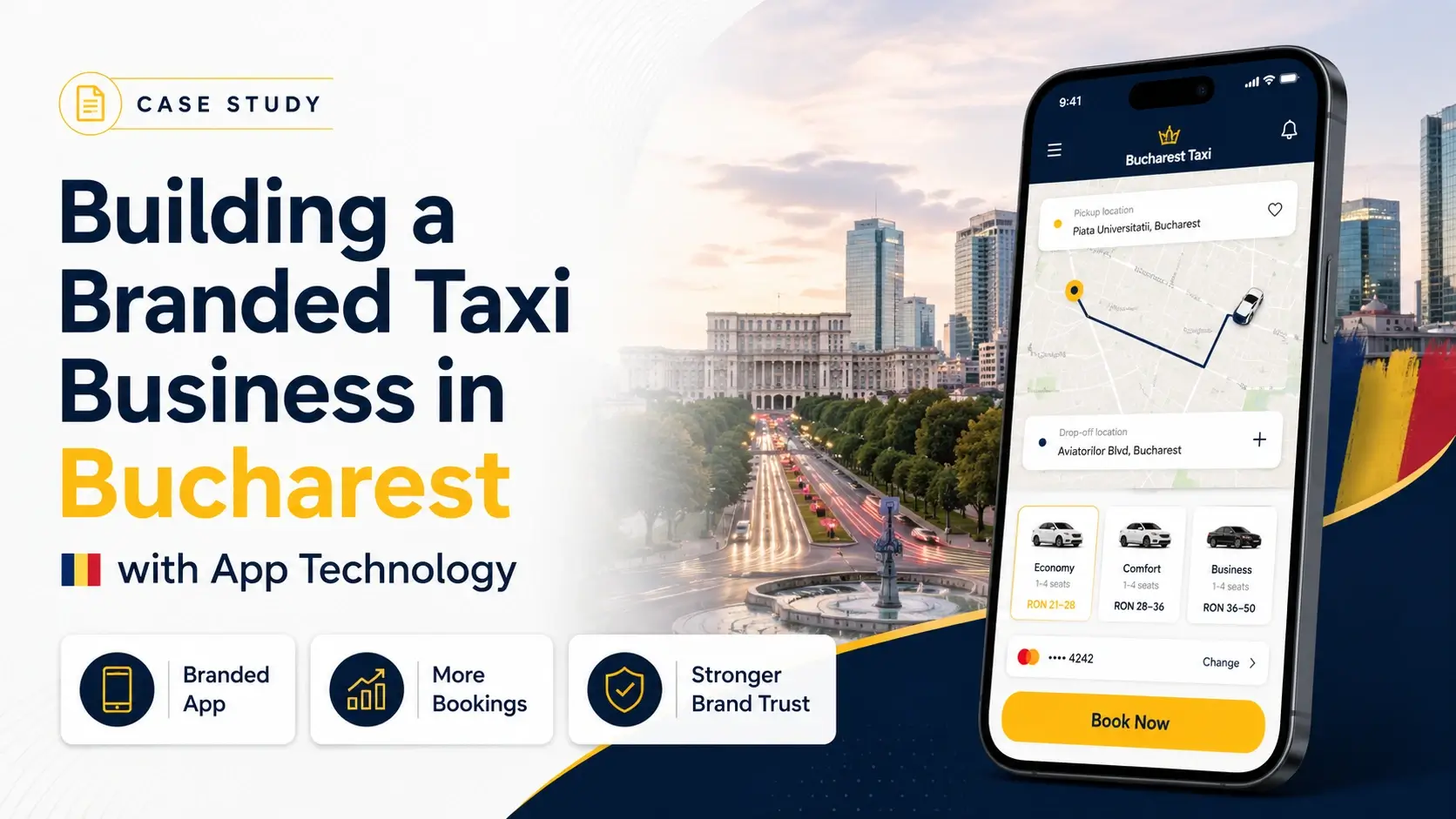
Case Study: Building a Branded Taxi Business in Bucharest with App Technology
Background
To illustrate how the strategies in this guide translate into real-world results, consider the journey of a taxi entrepreneur in Bucharest who launched a mid-size taxi operation in 2022 with a starting fleet of eight vehicles. Facing intense competition from Uber and Bolt, the founder needed a differentiated approach to capture a loyal customer base in Romania’s capital city.
The Challenge
The operator initially relied entirely on street hails and a telephone dispatch center. While this generated baseline revenue, it struggled to attract the growing segment of smartphone-first passengers who preferred app-based booking. Driver idle time was high, trip allocation was inefficient, and there was no mechanism to gather customer feedback or run loyalty promotions. The business needed to modernize quickly to remain relevant against app-native competitors.
The Solution
The operator partnered with a taxi app development company to deploy a white-label ride-hailing platform. The solution included a branded passenger app (available on Android and iOS), a driver app with real-time GPS navigation, and an admin panel for fleet monitoring, fare management, and reporting. Within six weeks of launch, the operator had a fully operational digital booking ecosystem running alongside their existing telephone dispatch. Key features implemented included in-app payments, ride scheduling, driver ratings, and a loyalty points system that rewarded frequent riders with free rides after every ten trips.
The Results
Within three months of app launch, 40% of all bookings were coming through the digital platform, reducing the load on the call center significantly. Driver idle time dropped by 25% due to smarter automated dispatch. The loyalty program drove a 30% increase in repeat bookings from registered app users. Average trip ratings improved from 3.8 to 4.6 out of 5 as drivers became more accountable through the in-app rating system. By the end of the first year, the operator had grown the fleet from eight to fifteen vehicles and expanded services to include a premium executive tier for airport transfers and corporate clients. Revenue grew by approximately 60% year-on-year. The case demonstrates clearly that combining strong local market knowledge with the right taxi technology platform allows independent operators in Romania to compete effectively against international ride-hailing giants while building a loyal, app-engaged customer base.
Conclusion
Starting a taxi business in Romania offers immense potential, with its growing urbanization, booming tourism, and demand for reliable transportation. Success requires a well-planned approach, from complying with local regulations to implementing innovative strategies for customer satisfaction and operational efficiency.
At Grepix Infotech, we specialize in cutting-edge taxi app development tailored to your business needs. Our solutions streamline bookings, enable GPS tracking, and offer seamless cashless payments, ensuring your business stands out in Romania's competitive market. Partner with Grepix Infotech to transform your vision into a thriving taxi business, delivering exceptional service and driving long-term success. Let’s build your future together!
FAQs
1. What are the costs of starting a taxi business in Romania?
Starting costs include purchasing or leasing vehicles, acquiring taxi licenses, insurance, and setting up a dispatch system or taxi booking app. A single-car operation may require €5,000–€15,000 in initial investment, while a fleet of five to ten vehicles can require €30,000–€80,000 depending on vehicle quality and technology choices. Ongoing expenses include fuel, driver salaries, maintenance, and marketing.
2. How long does it take to get a taxi license in Romania?
The licensing process can take several weeks to a few months, depending on the municipality. In cities like Bucharest where license numbers may be capped, acquiring an existing license from a retiring operator may add time and cost. Ensure you have all required documents including vehicle inspection certificates, insurance, criminal record clearance, and driver certifications ready before submitting your application to avoid delays.
3. Can a foreigner start a taxi business in Romania?
Yes, foreigners can start a taxi business in Romania, but you must hold a valid EU/EEA residence permit or comply with Romanian immigration regulations for non-EU nationals. Your business must be registered with the National Trade Register Office (ONRC), and all drivers must hold Romanian-recognized professional driver certificates. Collaborating with a local legal advisor and accountant can simplify the registration and compliance process significantly.
4. What are the legal requirements for a taxi business in Romania?
Vehicles must pass regular ITP inspections, meet Euro 5 or Euro 6 emission standards, and be equipped with a certified taximeter and a GPS system. Each taxi must display the taxi license number prominently and carry valid RCA and CASCO insurance. Drivers must hold a professional driver certificate (atestat profesional) issued by the Romanian Road Authority (ARR) and pass background checks. Operating under the CAEN 4932 activity code is required for tax registration purposes.
5. How can I compete with ride-hailing services like Uber and Bolt?
Focus on offering reliable service, transparent pricing, and excellent customer care. Launching your own branded taxi app gives your business the same digital convenience as Uber and Bolt while keeping commission fees in-house. Partnering with local hotels, businesses, and corporate clients, and emphasizing the safety and regulatory accountability of your licensed taxi service, can also give you a strong competitive edge over app-only platforms.
6. Do I need a separate license for airport taxi services in Romania?
Airport taxi operations in Romania are typically regulated by the airport authority in addition to the standard municipal taxi license. At Henri Coandă International Airport in Bucharest, for example, operators must be registered on an approved taxi service list and comply with specific pickup zone regulations. Contact the relevant airport authority directly to understand the authorization process before you begin offering airport transfer services.
7. What type of insurance is required for a taxi business in Romania?
Romanian taxi operators are required to carry mandatory third-party liability insurance (RCA) as a minimum. Most operators also invest in voluntary CASCO insurance covering vehicle damage, accidents, and theft, as well as passenger liability insurance. For a growing fleet, negotiating a group fleet insurance policy with a Romanian insurer can significantly reduce the per-vehicle premium cost.
8. How can a taxi app help grow my business in Romania?
A dedicated taxi booking app allows you to capture app-native customers who prefer booking rides digitally, automate dispatch to reduce driver idle time, collect valuable data on peak demand zones and customer preferences, and run loyalty programs and targeted promotions. It also eliminates third-party commission fees paid to aggregators like Uber or Bolt, maximizing your revenue per trip. White-label taxi app platforms from companies like Grepix Infotech allow you to launch a fully branded solution in weeks without building technology from scratch.
9. Is it profitable to start a taxi business in smaller Romanian cities?
Yes, smaller Romanian cities like Sibiu, Timișoara, Iași, and Oradea can be highly profitable for taxi operators, particularly because competition from international ride-hailing platforms is less intense than in Bucharest. These cities have growing student populations, increasing business tourism, and limited public transport options in suburban areas. A well-marketed local taxi service with a user-friendly booking app can quickly establish market leadership in these underserved markets.
10. Is a taxi business profitable in Romania?
Yes, when run with disciplined cost tracking and high vehicle utilisation. The biggest factor separating profitable operators from struggling ones is idle time vehicles that sit between bookings instead of being matched to new fares quickly. A booking and dispatch app that keeps cars moving, combined with weekly cost-per-kilometre tracking, is one of the simplest ways new operators improve their margins within the first few months.
Looking out to start your own venture like Uber? Try out our HireMe Taxi Uber Clone, the easiest way to kick-start your taxi business.